Table of Contents
The Pacific Northwest—particularly Portland’s dynamic event landscape—offers planners an enticing mix of historic charm, industrial aesthetics, and modern convention spaces. But while venue tours often focus on capacity, catering menus, and Instagram-worthy backdrops, they frequently overlook the technical infrastructure that determines whether your event will run smoothly or become a logistical nightmare. For AV production partners like Pro Connect Group, venue selection isn’t just about aesthetics—it’s about load-in accessibility, power capabilities, and acoustic integrity. These “hidden” technical factors directly impact labor costs, equipment requirements, and ultimately, your attendees’ experience. According to industry standards, inadequate site surveys and technical planning are among the leading causes of inflated production budgets and on-site safety issues. This guide examines Portland’s diverse venue landscape through the lens of professional AV production, providing event planners with a framework to evaluate technical readiness. Whether you’re planning a 50-person corporate retreat or a 5,000-attendee conference, understanding these production fundamentals will help you avoid costly surprises and deliver an event that looks as good as it sounds.
The Hidden Costs of “Pretty” Venues
Event planners often prioritize visual appeal over technical specifications, but this approach can lead to significant budget overruns and production challenges that compromise the attendee experience. Production management extends beyond equipment rental—it’s about integrating technology into physical spaces. Site surveys identify potential cost drivers before contracts are signed, transforming what could be budget-breaking surprises into well-planned production strategies. When AV professionals assess a venue early in the selection process, they’re evaluating far more than where to position speakers and screens; they’re analyzing whether the space’s fundamental infrastructure can support your event goals without requiring expensive workarounds. Portland’s aesthetic advantage becomes a technical challenge in many cases. The city’s popular repurposed warehouses and historic buildings often lack modern AV infrastructure, requiring expensive workarounds. That stunning exposed brick wall? It’s also an acoustic nightmare that will make your keynote speaker sound like they’re presenting from inside a cave. Those charming century-old buildings? They frequently lack the electrical capacity to power modern LED video walls without bringing in generators.
These aren’t minor line items—they represent budget allocations that could have been directed toward enhanced content, better catering, or extended marketing reach. Safety implications extend beyond finances. The Event Safety Alliance reports that difficult load-in conditions and rushed setups are primary causes of crew injuries in live production. When technical crews must hand-carry heavy equipment up multiple flights of stairs or navigate narrow doorways with oversized road cases, the risk of injury increases significantly. A venue that looks perfect during a leisurely afternoon tour can become a hazardous work environment at 6:00 AM when the production team arrives. Real-world impact on attendees often goes unmeasured but remains critical. Poor acoustics increase “listening effort,” leading to cognitive fatigue and reduced information retention—meaning your carefully crafted content may not land as intended. Research demonstrates that when audiences struggle to hear clearly in acoustically challenging spaces, they retain less information and experience higher mental fatigue, even if they’re not consciously aware of the problem.
What AV Professionals Look for During Site Surveys
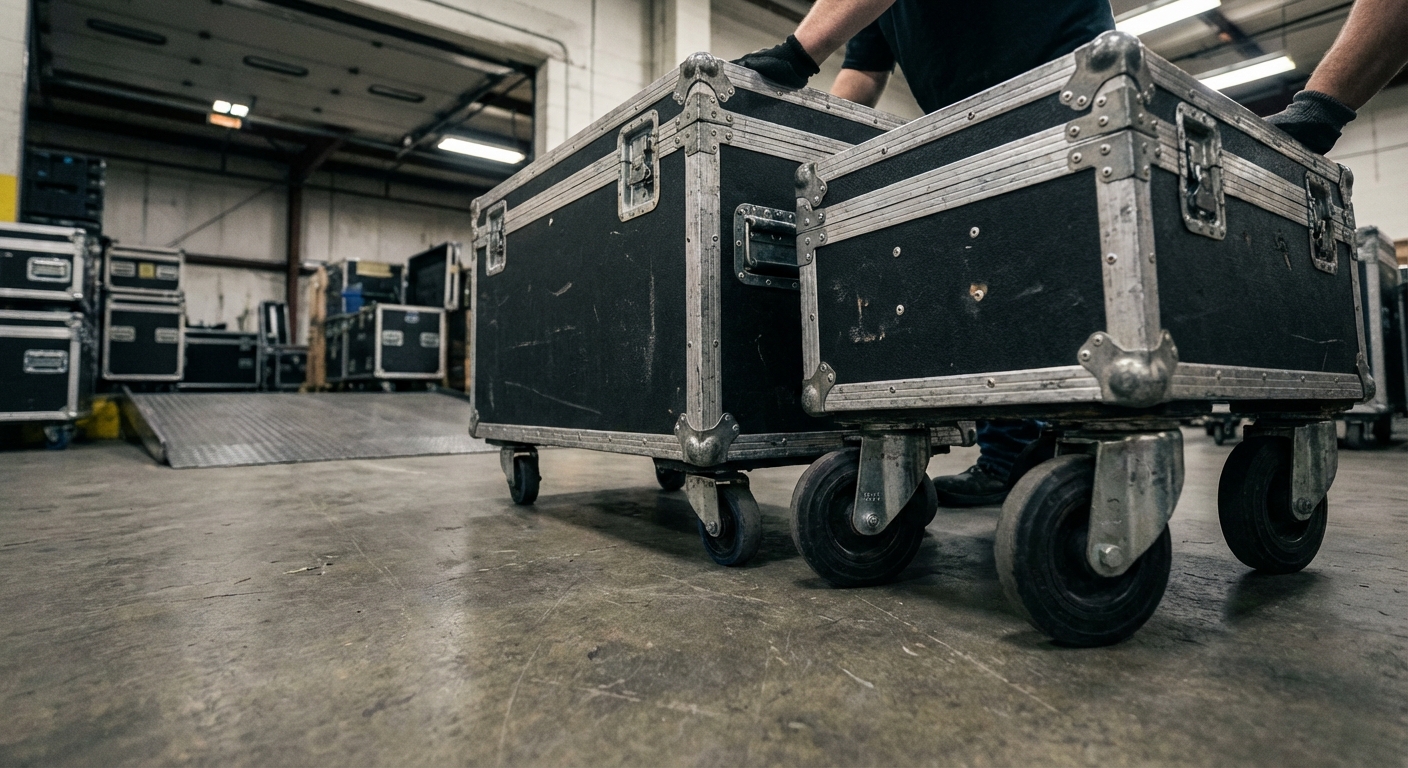
Understanding the three critical technical criteria—load-in logistics, power capabilities, and acoustics—helps planners identify venues that will support rather than sabotage their production goals.
Load-In Accessibility: The Foundation of Efficient Setup
Dock height matters more than most event planners realize. Standard semi-truck beds sit at 48 inches high. Venues lacking proper loading docks require lift-gate trucks or ramps, adding 2-4 hours to setup time. This isn’t just an inconvenience—it’s a direct labor cost increase that affects your bottom line. When production crews must use lift gates, they’re limited to moving smaller loads with each trip, multiplying the time required to transport equipment from truck to venue. Vertical transport requirements create additional challenges in multi-story venues. Freight elevators must accommodate road cases exceeding 500 pounds and measuring several feet in each dimension. Narrow doorways or inadequate elevator capacity can necessitate hand-carrying equipment up multiple flights of stairs—a scenario that’s both time-consuming and potentially dangerous. Pro Connect Group has encountered historic venues where the only access to the ballroom required navigating three flights of stairs through a service corridor designed in the 1920s. The time and labor impact of poor access can add $800-$2,000 in additional crew costs for a single-day event. When your production team needs to arrive four hours earlier than planned, or when additional crew members must be brought in to manually transport equipment, those costs accumulate quickly. For multi-day conferences, the impact multiplies across setup, daily adjustments, and teardown.
Power Capabilities: More Than Just Wall Outlets
Three-phase power requirements represent one of the most common surprises for planners selecting venues without AV consultation. Modern LED video walls and intelligent lighting rigs require 200A or 400A three-phase Camlock disconnects—standard Edison outlets simply won’t provide sufficient power. The difference isn’t just capacity; it’s about the type of electrical service required to safely operate professional production equipment. Distance to power source affects both safety and cost. If disconnects are more than 100 feet from the stage area, heavy gauge feeder cable is required, increasing rental costs by $500-$1,500 per event. These specialized cables are expensive to rent and require trained technicians to properly terminate and deploy, adding both equipment and labor costs. Code compliance isn’t optional. All temporary power distributions must adhere to National Electrical Code Article 520, which governs theatrical installations. This means licensed electricians may be required for panel tie-ins, adding another layer of cost and coordination. Venues that haven’t been designed with production in mind often lack the proper infrastructure for code-compliant temporary power distribution.
Acoustic Integrity: The Most Overlooked Factor
Reverberation Time (RT60) provides a quantifiable measure of acoustic quality. Spaces with RT60 exceeding 1.5 seconds severely degrade speech intelligibility—a common issue in Portland’s “industrial chic” venues with exposed brick and concrete. RT60 measures how long it takes for sound to decay by 60 decibels, and higher numbers indicate that sound continues bouncing around the room long after it’s produced, creating a muddy acoustic environment.
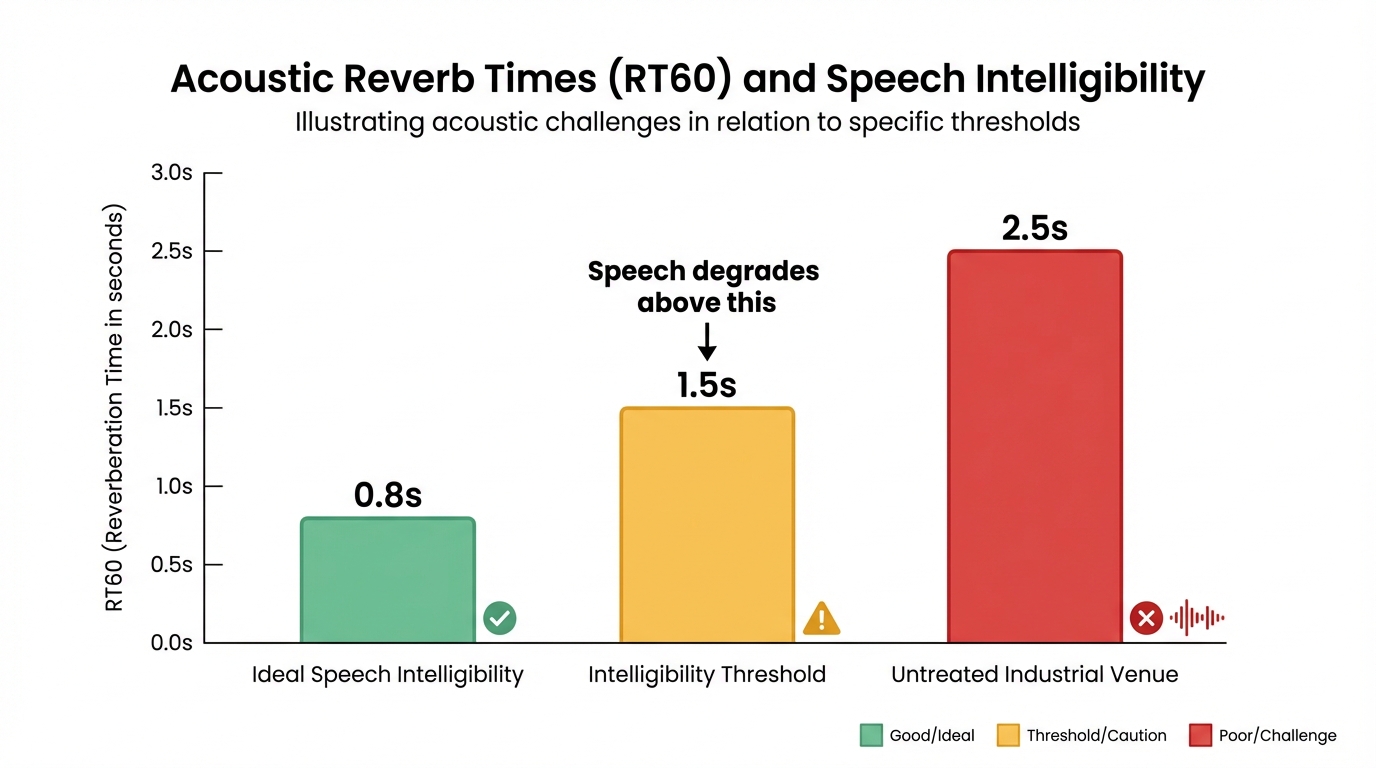
The data clearly shows how different venue types affect sound quality. Convention centers, designed with acoustic treatment in mind, maintain RT60 levels that support clear speech intelligibility. Historic ballrooms benefit from architectural details like curtains and carpeting that naturally absorb sound. Industrial spaces, despite their visual appeal, create the most challenging acoustic environments that require significant technical intervention. Architectural challenges require creative solutions. Hard surfaces act as acoustic mirrors, bouncing sound repeatedly and creating echo effects that make speech difficult to understand. Correcting these issues requires either physical acoustic treatment (pipe-and-drape installations, temporary wall coverings) or complex digital signal processing that uses sophisticated audio equipment to electronically compensate for poor room acoustics. Solution costs for acoustic challenges can add $1,000-$3,000 to production budgets. Pro Connect Group often deploys distributed speaker systems in acoustically problematic venues—using more speakers at lower volume rather than fewer loud speakers—to minimize the distance sound must travel before reaching listeners, thereby reducing the impact of room reflections.
From Convention Centers to Warehouses: How Portland Venues Stack Up
Portland’s diverse venue landscape falls into three primary archetypes, each presenting distinct advantages and challenges for AV production. Understanding these categories helps planners set realistic expectations and budget appropriately.
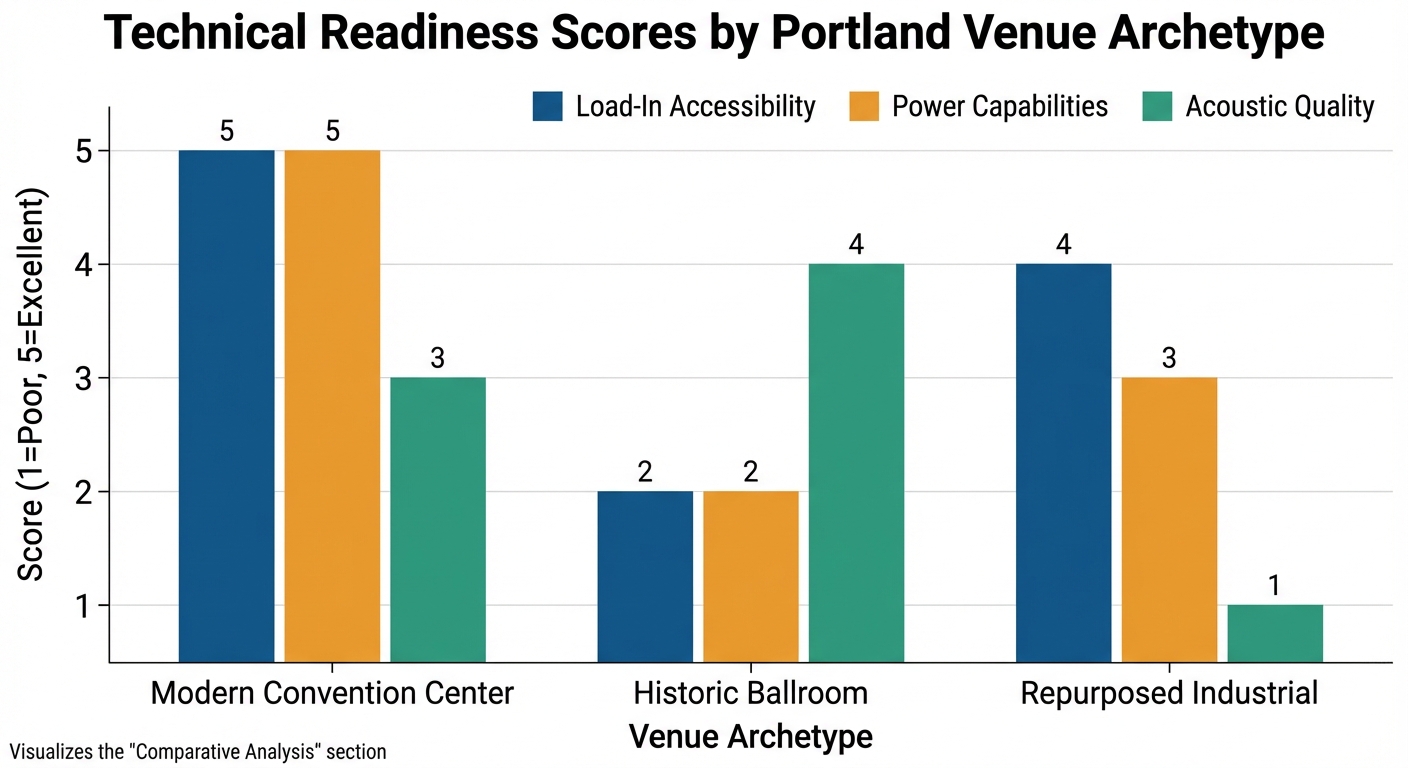
This technical assessment reveals significant variation in production readiness across venue types. Convention centers score highest across all three critical criteria—load-in access, power infrastructure, and acoustic design. Historic ballrooms offer moderate technical capabilities with strong acoustic performance but often challenging logistics. Industrial spaces, while visually striking, present the greatest technical challenges, particularly in acoustic management.
The Modern Convention Center
The Oregon Convention Center exemplifies production-ready infrastructure. With more than 255,000 square feet of LEED Platinum certified space, the OCC was designed from the ground up to accommodate large-scale events with complex technical requirements. Production advantages include:
- Comprehensive power access through floor pockets and overhead grids, eliminating long cable runs and reducing setup time
- Dedicated loading docks with levelers accommodate full-sized tractor-trailers, allowing efficient equipment transfer
- Ballrooms feature acoustic treatment specifically engineered for speech intelligibility
- Structural rigging points rated for production loads eliminate need for ground support systems
Challenges remain even in purpose-built venues. Exhibit halls can have high RT60 due to their sheer size and hard flooring, requiring strategic speaker placement and occasionally supplementary acoustic treatment. The scale of these spaces also demands more extensive cable runs and larger equipment packages, though the infrastructure exists to support these requirements. Best suited for: Large conferences, trade shows, and multi-day events requiring extensive rigging. When your event involves heavy video walls, complex lighting designs, or multiple breakout sessions requiring simultaneous technical support, convention centers provide the infrastructure that makes production efficient and cost-effective.
The Historic Ballroom
Historic venues like the Portland Art Museum’s Kridel Grand Ballroom offer elegance and architectural distinction that many modern spaces cannot match. These spaces evoke a sense of occasion that resonates with attendees and creates memorable experiences. Production advantages:
- Generally good acoustics from architectural detailing—carpet, curtains, ornate wall treatments, and coffered ceilings
- Intimate scale often requires minimal audio system complexity to achieve excellent intelligibility
- Established relationships with preferred vendors who know the space intimately
Challenges:
- Power systems often retrofitted, requiring careful verification of Camlock availability and capacity
- Licensed electricians may be needed to tie into the building’s main electrical panel
- Narrow doorways designed for a different era create load-in challenges
- Freight elevators (if they exist) may not accommodate modern road cases
Best suited for: Galas, awards ceremonies, and corporate dinners where elegance outweighs technical complexity. Events centered on human connection rather than elaborate production elements benefit from the atmosphere these spaces provide without triggering the technical challenges that more equipment-intensive productions would face.
The Repurposed Industrial Space
Venues like Castaway Portland and Leftbank Annex represent Portland’s unique contribution to event space design—industrial warehouses transformed into modern event venues while retaining their raw aesthetic appeal. These spaces photograph exceptionally well and create distinctive environments. Production advantages:
- Straightforward load-in via street-level roll-up doors, allowing trucks to back directly up to the event space
- Many venues have undergone electrical modernization, providing adequate three-phase power in accessible locations
- Open floor plans offer flexibility in layout and equipment positioning
- High ceilings accommodate theatrical lighting and projection without obstruction
Challenges:
- Severe acoustic issues require distributed speaker systems and careful audio engineering to overcome
- Concrete floors, exposed brick walls, and high ceilings create echo chambers
- Limited truck marshaling space in urban locations can create logistical coordination challenges
- Temperature control may be inadequate for comfortable year-round events
Pro Connect Group has developed specialized audio approaches for these challenging acoustic environments, deploying arrays of smaller speakers positioned strategically throughout the space rather than relying on traditional “left-right” main speaker configurations. This approach delivers clear audio while minimizing the problematic reflections that plague industrial spaces. Best suited for: Product launches, experiential marketing events, and receptions where aesthetic impact matters most. When the visual environment is central to your event concept and when presentation requirements are moderate, industrial spaces deliver memorable experiences that distinguish your event from conventional alternatives.
Understanding the True Cost of Venue Selection
A comprehensive look at how venue infrastructure directly affects production budgets reveals patterns that can inform better planning decisions. The financial impact of technical specifications extends well beyond the venue rental rate.
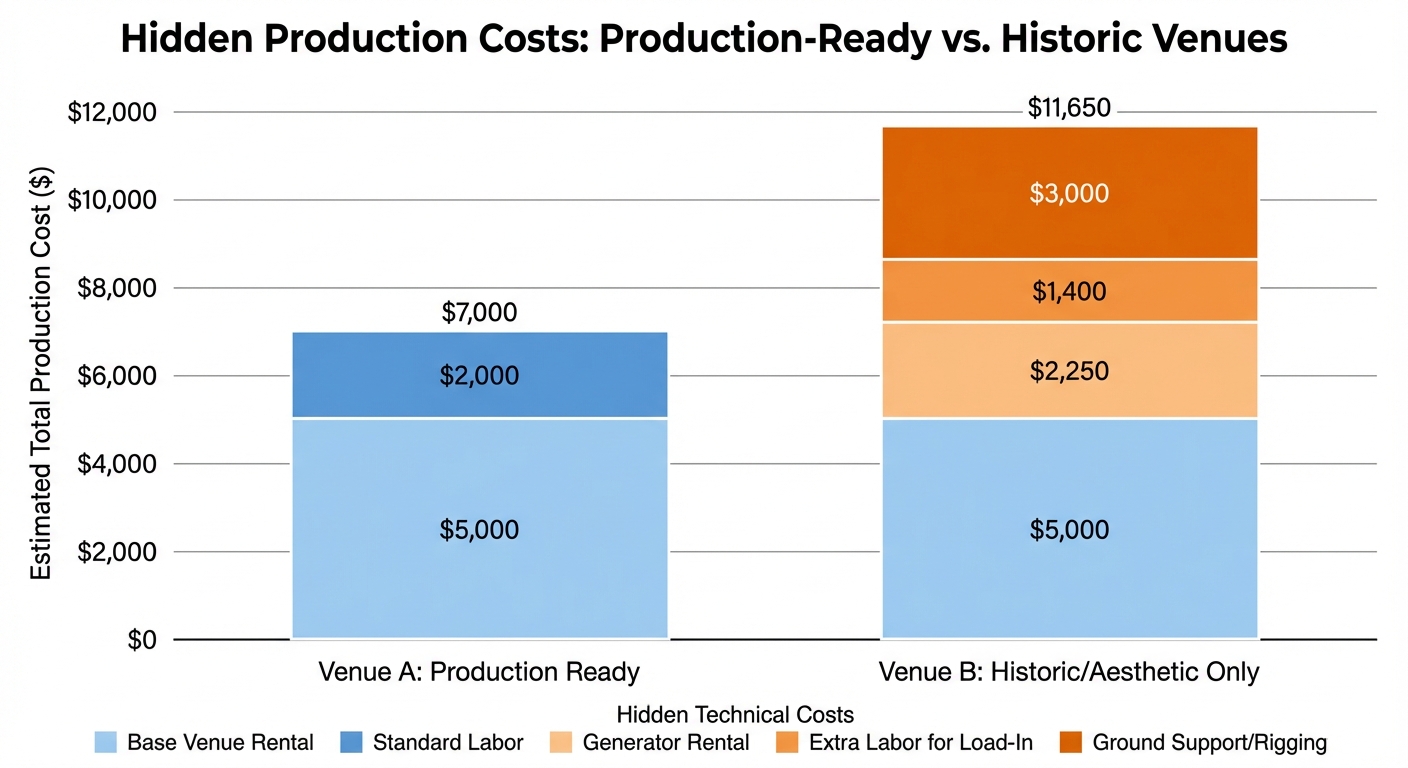
This cost comparison illustrates the hidden expenses that emerge when venues lack production-ready infrastructure:
| Cost Category | Production-Ready Venue | Aesthetically-Focused Venue | Variance |
|---|---|---|---|
| Power/Generator | Included | $1,500-$3,000 | +$1,500-$3,000 |
| Rigging/Ground Support | Included | $2,000-$5,000 | +$2,000-$5,000 |
| Extended Load-In Labor | Standard | $800-$2,000 | +$800-$2,000 |
| Acoustic Treatment | Minimal | $1,000-$3,000 | +$1,000-$3,000 |
| Total Additional Costs | — | — | +$5,300-$13,000 |
Real-world budget impact: Consider a hypothetical 300-person corporate event with standard production requirements: projection, sound reinforcement, basic lighting, and live streaming capabilities. At a production-ready venue like the Oregon Convention Center, the production budget might total $15,000, covering equipment rental, labor for setup and operation, and technical direction. The venue’s infrastructure supports all requirements without workarounds or additional expenses. At an aesthetically-focused industrial space lacking production infrastructure, that same event might require $22,000-$28,000 in production costs. The differential includes generator rental for inadequate power ($2,500), ground support trussing for lighting without structural load points ($3,500), extended labor for difficult load-in ($1,500), and acoustic treatment plus complex audio arrays to combat severe reverb ($2,500).
Strategic planning recommendations:
- Involve AV partners during venue selection, not after contracts are signed
- Request technical specifications during venue tours—power diagrams, load-in access photos, structural drawings showing rigging capabilities, and acoustic reports if available
- Factor production requirements into venue budget allocation from the outset—industry standards suggest 15-25% of total event budget to production, but venues lacking technical readiness can push costs to 30-35%
- Consider long-term implications for recurring events—a venue requiring extensive workarounds will create the same challenges every time
Hybrid Capabilities and the New Venue Standard
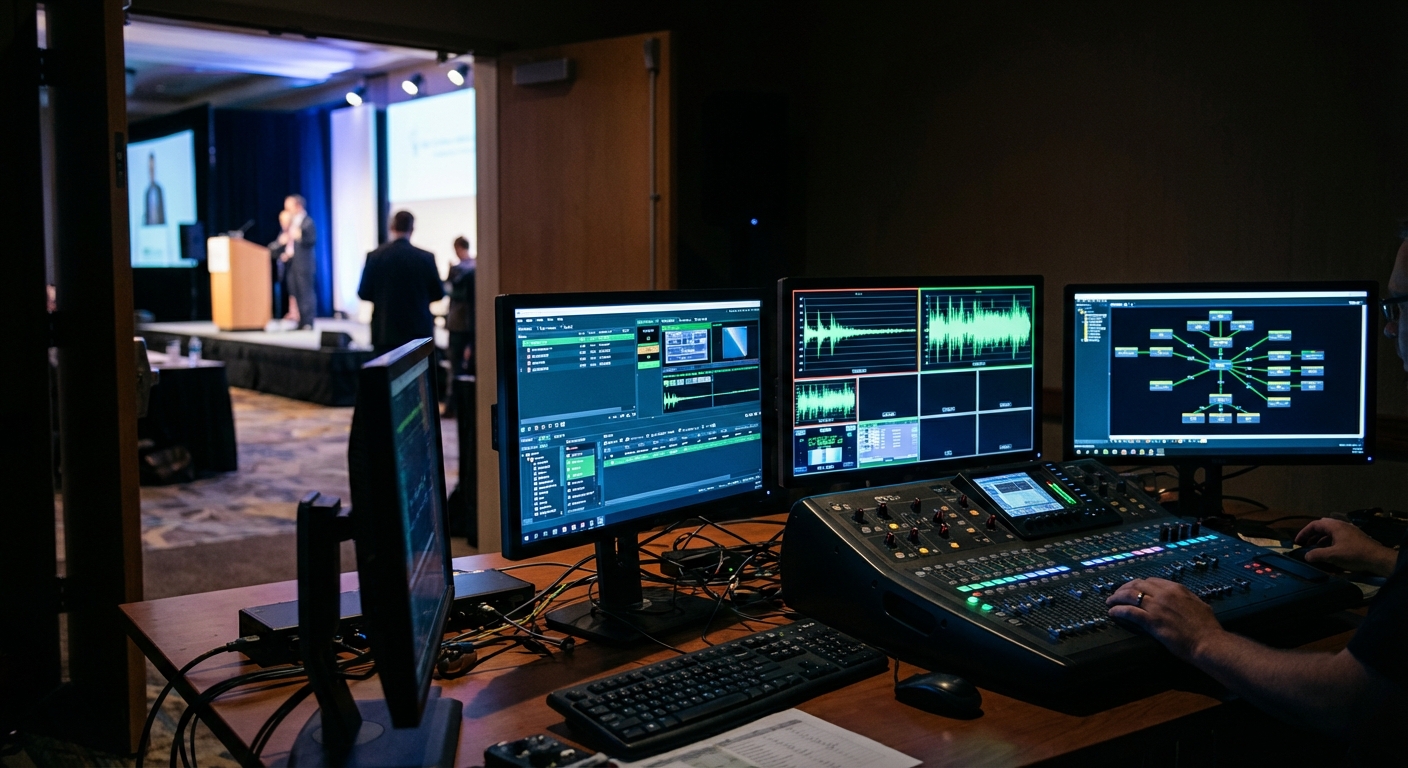
The post-pandemic event landscape has fundamentally shifted venue requirements, with robust internet infrastructure now as critical as traditional AV considerations. Hybrid events—those supporting both in-person and virtual audiences simultaneously—have evolved from pandemic necessity to standard expectation. The hybrid event revolution has redefined venue selection criteria:
- Bandwidth has become a deal-breaker—67% of event planners now consider internet bandwidth essential for site selection, driven by live streaming demands
- Fiber backbones provide the dedicated, symmetrical bandwidth required for broadcast-quality streaming, while Wi-Fi-only venues often struggle
- Upload speed requirements are substantial—streaming a single HD broadcast requires minimum 50 Mbps dedicated upload capacity, with 4K streaming demanding even more
- Multiple simultaneous streams (breakout sessions broadcast to different virtual audiences) require proportionally greater capacity
Portland market trends reflect increasing awareness: A growing number of historic and industrial spaces are investing in technical infrastructure upgrades, recognizing that maintaining competitiveness requires more than aesthetic appeal. Fiber installation, dedicated network switches for event production, and hardwire connection points in strategic locations are becoming standard amenities. Sustainability considerations are influencing venue selection among corporate clients with environmental, social, and governance mandates. LEED-certified venues like the Oregon Convention Center attract organizations seeking to align event choices with corporate sustainability commitments. These venues often feature energy-efficient systems, waste reduction programs, and sustainable operational practices that support client ESG reporting requirements. Multi-use flexibility has become increasingly valuable:
- Venues offering modular spaces that can accommodate both in-person and virtual audiences
- Rooms with permanent camera positions, dedicated streaming equipment storage
- Network infrastructure designed for hybrid production reduces setup complexity and costs
Future-proofing considerations:
- 5G integration is emerging at some newer venues, potentially enabling cellular broadcast capabilities
- Integrated AV systems—permanent installations of projection, sound, and lighting systems reduce setup complexity
- Technical concierge services—venues partnering with preferred AV vendors like Pro Connect Group for streamlined coordination
As virtual events become the standard rather than the exception, venue selection criteria must evolve beyond traditional metrics. Planners should prioritize spaces that can seamlessly support both physical and virtual audiences without requiring extensive technical workarounds. The venues that will thrive in this new landscape are those investing in infrastructure that supports evolving technical requirements while maintaining the aesthetic and functional qualities that make events memorable.
Key Takeaways
Selecting the right venue in Portland’s diverse event landscape requires looking beyond aesthetics and capacity to evaluate the technical infrastructure that enables seamless production. While the city’s industrial warehouses, historic ballrooms, and modern convention centers each offer unique atmospheric advantages, their production readiness varies dramatically. Essential insights for event planners:
- Involve your AV production partner early in the venue selection process—a 30-minute technical site survey can identify potential cost drivers before you sign a contract
- Understand the three pillars of production-ready venues: load-in accessibility, power capabilities, and acoustic integrity
- Budget realistically—venues lacking technical infrastructure can increase production costs by 47-87% compared to production-ready alternatives
- Prioritize hybrid capabilities—dedicated upload bandwidth and hardwired connections are now essential, not optional
- Consider the total cost of venue selection, including hidden production expenses that impact ROI
At Pro Connect Group, we’ve seen firsthand how proper venue selection sets the foundation for event success. Whether you’re drawn to the industrial charm of Castaway Portland or the turnkey infrastructure of the Oregon Convention Center, understanding these technical fundamentals ensures your audience can hear every word, see every slide, and experience your event exactly as intended. The investment in technical evaluation pays dividends throughout the event planning process. When you know your venue’s capabilities and limitations from the outset, you can make informed decisions about production design, budget allocation, and schedule planning. You can focus on creating compelling content and meaningful attendee experiences rather than solving preventable technical challenges.
Planning an Event in the Pacific Northwest?
Get a complimentary venue technical assessment from Pro Connect Group’s production experts. We’ll evaluate potential spaces before you commit, ensuring your venue choice supports rather than sabotages your event goals.
Our team provides detailed analysis of load-in logistics, power infrastructure, and acoustic characteristics, along with budget estimates that reflect actual production requirements.
Visit Pro Connect Group to learn more about our comprehensive event production solutions.
References:
- AVIXA. (2023). Standard Guide for Audiovisual Systems Design and Coordination Processes. Retrieved from https://www.avixa.org/standards/standard-guide-for-audiovisual-systems-design-and-coordination-processes
- Event Safety Alliance. (2024). The Event Safety Guide: Crowd Management and Production Safety. Retrieved from https://www.eventsafetyalliance.org/the-event-safety-guide
- Acoustical Society of America. (2018). Speech Intelligibility and Cognitive Effort in Classrooms and Meeting Rooms. Retrieved from https://asa.scitation.org/doi/10.1121/1.5031119
- NFPA. (2023). NFPA 70: National Electrical Code (Article 520). Retrieved from https://www.nfpa.org/codes-and-standards/all-codes-and-standards/list-of-codes-and-standards/detail?code=70
- Oregon Convention Center. (2024). Facility Guide and Floor Plans. Retrieved from https://www.oregoncc.org/en/planners/floor-plans-specs
- Skift Meetings. (2023). State of the Event Industry Report: Hybrid Tech Trends. Retrieved from https://skift.com/meetings/
PCG serves clients across the Pacific Northwest: AV Production — Vancouver, WA · Event Production — Salem, OR · AV Services — Bend, OR