
If you’re planning a corporate event, conference, gala, or entertainment-driven show in Portland or anywhere in the Pacific Northwest and you’re weighing video options, two systems will dominate the conversation: LED walls and projection screens. Both can deliver compelling visuals. But they perform very differently depending on ambient light, venue geometry, content type, and budget — and choosing the wrong one affects every person in the room. This guide explains how each system works, where each excels, and how to have a productive conversation with your audio video lighting production company before your next event.
Key Takeaways
- LED walls generate their own light and hold up in bright, ambient-light environments — ballrooms, trade show floors, daytime conferences, outdoor stages.
- Projection works best in darkened or semi-controlled spaces and typically costs less for standard indoor presentations.
- Brightness, pixel pitch, throw distance, and screen size all factor into the right choice for your venue.
- For IMAG (image magnification), livestreaming, or camera recording, LED walls broadcast more cleanly.
- Many events use a hybrid approach: LED on the main stage, projection in breakout rooms.
- Share your venue dimensions, ambient light situation, run-of-show, and content type with your AV production partner early — those details drive the right spec.
How Each Technology Works
LED Video Walls
An LED wall is built from individual panels — each containing thousands of tiny light-emitting diodes — assembled into a seamless display surface. Because the panels create their own light, image quality stays consistent regardless of how bright the room is. Modern LED panels used in event production typically achieve brightness levels above 1,000 nits, with premium outdoor-rated units exceeding 5,000 nits — far more than even a high-end laser projector can maintain on a screen in comparable ambient conditions.
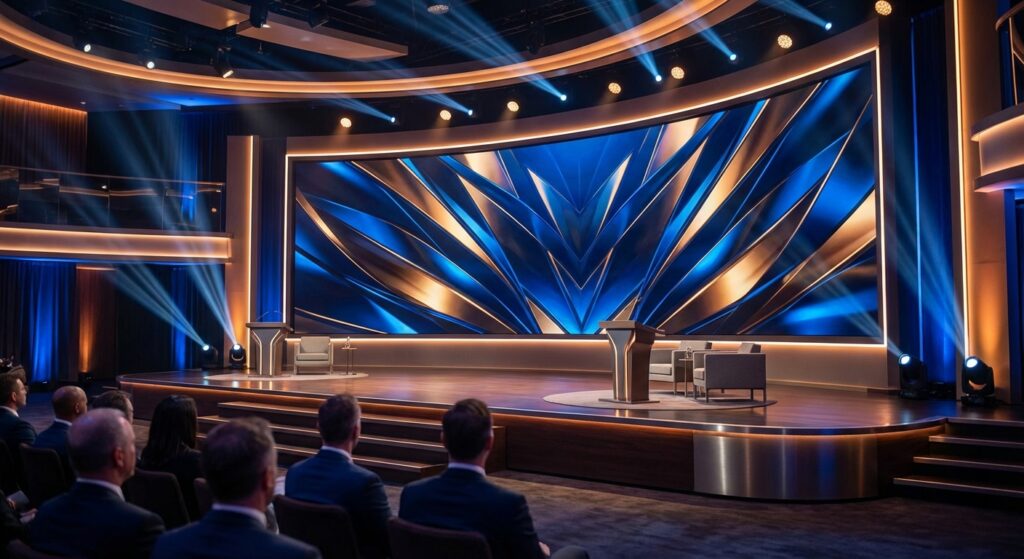
LED walls are modular: production teams can configure them in almost any dimension, curve them for scenic effect, stack multiple sections for wide-format looks, or fly them from truss. This flexibility makes them well-suited to complex staging where the visual system needs to conform to the set design, not the other way around.
The key variable in LED wall specs is pixel pitch — the distance between individual LED clusters, measured in millimeters. A finer pixel pitch (e.g., P2.6 or P3.9) means higher resolution at closer viewing distances. A coarser pitch (P6 or above) is appropriate for large stages where the audience sits farther away. Your production company will match pixel pitch to your screen size and minimum viewing distance so you’re not over-spending on resolution no one can perceive — or under-speccing a wall that looks pixelated up close.
Projection Systems
A projector throws an image onto a screen surface — either front-projection (projector aimed from in front of the screen) or rear-projection (projector placed behind the screen and hidden from the audience). Image quality depends on the projector’s brightness output (measured in ANSI lumens), the gain and reflectivity of the screen, and how much competing ambient light is in the room.
Modern laser projectors have largely replaced lamp-based units in professional event production, offering more stable brightness over time, faster warm-up, and better color consistency. High-end laser projectors for large venues can produce 20,000 lumens or more, which is sufficient for many indoor conference and ballroom setups. But projection still fundamentally relies on controlling ambient light to protect image contrast — a constraint LED walls don’t face.
When an LED Wall Is the Right Call
An LED wall is usually the stronger choice when one or more of these conditions apply:
- The venue has significant ambient light. Windows, daytime schedules, or ballrooms with chandeliers that can’t be fully dimmed will wash out a projected image. LED walls stay vibrant regardless.
- The event uses IMAG (image magnification). When cameras feed a live presenter image to the screen so back-row attendees can follow along, LED walls display that feed with higher fidelity and the image photographs cleanly for recording or broadcast.
- Livestream or video recording is part of the show. Cameras often struggle with projection — they can pick up beam geometry or flicker. LED walls record without those artifacts.
- Stage design is a priority. If the display is meant to be a scenic element — a branded backdrop, a dynamic motion canvas, a wide-format statement piece — LED allows far more creative flexibility.
- The event runs from daytime into evening. LED brightness stays consistent through the full run-of-show without needing to adjust house lighting or blackout windows mid-event.
In our experience producing events ranging from tech company general sessions to Pacific Northwest galas, LED walls dramatically change what’s possible for branding and visual storytelling — especially when the stage design and AV production teams are working together from the start of the planning process.
When Projection Is the Right Call
Projection remains a smart, cost-effective choice when these conditions apply:
- The room has good light control. A hotel ballroom, theater, or conference space where house lights can drop gives a quality laser projector everything it needs to deliver an excellent image at a lower price point.
- Content is primarily presentation decks. Keynote slides, data charts, and standard corporate presentations don’t demand the brightness or motion performance of an LED wall to look sharp in a controlled environment.
- Budget needs to spread across the full production. Allocating dollars to audio quality, lighting design, and experienced crew depth rather than a premium video surface can be the right strategic call when venue conditions support it.
- Multiple rooms need coverage. Running projection in a main session room and several breakout spaces is often far more cost-efficient than LED in every room.
- Rear-projection is feasible. In venues where projector placement behind the screen is practical, rear-projection removes shadow interruptions when presenters move in front of the screen — a real advantage at conferences where speakers tend to roam.
What Does Event Video Production Cost?
Costs vary by screen size, market, and production scope, but here are realistic ballpark figures for the Pacific Northwest market in 2025–2026:
- LED wall rental (medium setup, ~12×7 ft): $2,500–$5,000 per day for panels, processor, and basic crew. Larger configurations (20×12 ft and up) typically run $6,000–$12,000+ per day including delivery, setup, and on-site technical operation.
- Projection (single large-screen ballroom setup, 12,000–20,000 lumens): $1,500–$3,500 per day for projector, screen, and basic crew. High-brightness or dual-stack setups for very large rooms run higher.
According to data from Royal Display, LED panel rental rates typically run $150–$400 per panel per day before crew and logistics costs — so the total for a mid-size wall can climb quickly as panel count grows. The most useful frame for budget conversations isn’t a per-item price sheet: it’s what visual outcome you need, in what venue, for what audience. That question produces a more useful comparison than LED vs. projection on cost alone.
Hybrid Video Setups: Using Both
Many well-produced corporate events and galas use both technologies — and that’s often the most practical approach. A common hybrid configuration: LED wall on the main stage for full-room visibility and brand impact, projection screens in breakout rooms where content is presentation-heavy and room sizes are smaller. The LED carries the production value where it matters most; projection handles the utilitarian coverage efficiently.
Hybrid setups also apply within a single room. A wide scenic LED panel behind the stage supplemented by side-fill projection screens for closer content reading in a large ballroom lets audiences at different distances all follow the content clearly — without requiring an LED installation sized to cover every sightline in a sprawling space.
How to Brief Your AV Production Company
Getting an accurate recommendation — and an accurate quote — starts with sharing the right information early. When you contact an AV production company for video system planning, come prepared with:
- Venue name and room dimensions (length, width, ceiling height)
- Ambient light situation: windows, skylights, chandeliers, time of day for the event
- Audience size and layout: number of seats, seating arrangement, approximate distance from the screen to the back row
- Content type: slides, video playback, IMAG, motion graphics, sponsor loops, live camera feeds — or a mix
- Run-of-show context: keynote session, awards show, concert, product reveal, cocktail reception?
- Livestream or recording needs: will cameras be in the room, and is this being broadcast?
- Budget range: even a ballpark helps production teams propose solutions that actually fit
The more context you provide upfront, the more confidently a production company can recommend the right video system — and the fewer surprises arise during load-in or show day.
Frequently Asked Questions
Is an LED wall better than a projector for corporate events?
It depends on the venue and lighting conditions. LED walls are generally better for corporate events in bright ballrooms, daytime sessions, or any setting where house lights can’t be fully dimmed. They also perform better for IMAG, livestreaming, and branded visual statements. Projection can be the right choice in controlled-light environments where cost efficiency is a priority and content is primarily presentation-based.
How much does it cost to rent an LED wall for an event?
For a medium-size event setup (roughly 12×7 feet), expect $2,500–$5,000 per day including panels, processor, and crew in most Pacific Northwest markets. Larger main-stage configurations can run $8,000–$15,000+ for a full production day including delivery, technical setup, and a qualified operator on-site. Costs vary by panel size, pixel pitch, and local market rates.
Can you use an LED wall outdoors?
Yes — and it’s often the only practical choice for outdoor events during daylight hours. Outdoor-rated LED panels are weatherproofed and achieve brightness levels of 3,000–8,000 nits or more, keeping the image clearly visible even in direct sunlight. Outdoor projection is rarely effective before sunset. Your production company should confirm IP ratings and appropriate brightness specifications for your outdoor setup.
What is pixel pitch and does it matter for events?
Pixel pitch is the distance between individual LED pixel clusters on a panel, measured in millimeters. A lower number (e.g., P2.9) means finer resolution — important for smaller screens or closer viewing distances. A higher number (e.g., P6) is fine for large screens viewed from 30+ feet away. Your AV production company will match pixel pitch to your screen dimensions and audience seating distance so the resolution is appropriate without over-spending.
Can I use projection in a room with windows?
You can, but natural light from windows dramatically reduces contrast on a projection screen, making slides and video difficult to read — especially from the back of the room. Common solutions include covering windows with blackout drape (a standard production option), scheduling content sessions after dark, or switching to LED for that environment. A good production company will flag this issue during site survey or early venue conversations.
Ready to Plan Your Event Video System?
Whether you’re leaning toward an LED wall, projection, or a hybrid setup, the most important step is talking to an AV production company early — before the venue contract is signed if possible. Pro Connect Group provides full audio, video, and lighting production for corporate events, conferences, galas, and live entertainment throughout Portland, Oregon and the Pacific Northwest. We spec video systems based on your actual venue, content, and audience — not a one-size-fits-all package. Contact our team to discuss your next event and get a production plan built for what you’re building.
View our LED wall and video display inventory: PCG Equipment Inventory →