Table of Contents
The return of in-person events has raised the stakes for technical execution. Today’s audiences expect seamless audio, crisp visuals, and flawless presentations—anything less can undermine your message and damage your brand reputation. Yet many event organizers face a critical decision: should they rent equipment and handle production themselves, or invest in full-service production support?
This isn’t simply a budget question. According to the American Express Global Business Travel 2024 Forecast, 67% of meeting professionals predict increased spending on events this year, driven by demand for higher-quality experiences. The choice between “dry hire” equipment rentals and comprehensive production management fundamentally impacts risk exposure, attendee engagement, and return on investment.
For corporate event planners, technical directors at houses of worship, and nonprofit organizers, understanding these two approaches is essential. This article explores the hidden costs of DIY setups, reveals why professional production management delivers measurable ROI, and provides a framework for making the right decision for your next event.
Understanding the Two Approaches
What Separates Equipment Rental from Full-Service Production?
Before weighing costs and benefits, event organizers must understand the fundamental differences between these service models and what each includes.
Dry Hire Defined: Equipment rental without operational support—clients receive speakers, microphones, projectors, and screens but handle setup, operation, and troubleshooting themselves. You get the boxes, but you’re on your own for everything that happens after delivery.
Full-Service Production Defined: An integrated approach combining equipment, certified technicians, Production Managers, and strategic planning from pre-event advancement through load-out. This isn’t just about delivering gear—it’s about taking ownership of your event’s technical success from beginning to end.
The Stewardship Difference: Pro Connect Group’s philosophy positions production partners as taking genuine ownership of technical success, not just delivering boxes of gear. This stewardship approach means your production team is invested in your outcomes, not just completing a transaction.
When Rentals Make Sense: Small breakout rooms, informal internal meetings, or situations where organizations employ in-house certified technicians with capacity to manage technical execution can benefit from straightforward equipment rentals. If you have a qualified technical staff member available and the event stakes are relatively low, rentals provide a cost-effective solution.
When Production is Essential: Corporate keynotes, galas, concerts, hybrid broadcasts, or any event where brand reputation and message clarity are paramount require professional production management. When external stakeholders are watching, when fundraising dollars are on the line, or when your CEO is delivering a critical message, the technical execution must be flawless.
The Modern Complexity Factor: Today’s AV systems are increasingly software-based, requiring specialized training in digital mixing consoles, LED processors, video switching, and signal flow management. The days of simply “plugging in speakers” are long gone. Modern production technology demands expertise that most organizations don’t maintain in-house.
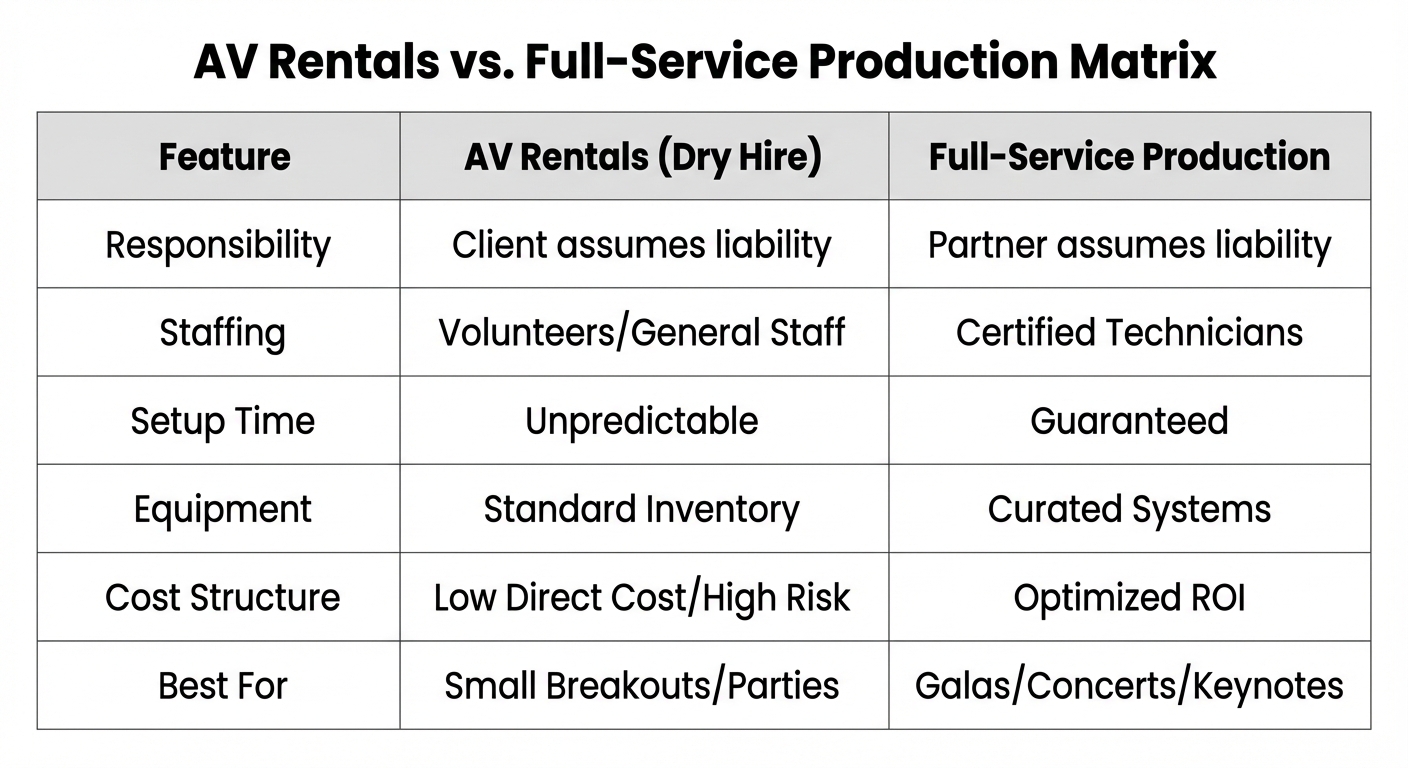
This comparison matrix illustrates the fundamental differences between these two approaches. Notice how responsibility, staffing expertise, and intended use cases diverge significantly—understanding these distinctions is the first step toward making an informed decision for your event.
The Hidden Economics of DIY Event Production
Why “Cheaper” Equipment Rentals Often Cost More
The rental invoice represents only a fraction of the total cost of DIY event production—inefficiencies, failures, and missed opportunities create substantial hidden expenses that rarely appear on initial budget projections.
Opportunity Cost of Misallocated Labor: When your marketing coordinator spends six hours troubleshooting microphone connections instead of managing attendee engagement strategies, you’ve misallocated valuable professional time. These hours represent billable expertise being wasted on technical problems that specialized technicians could resolve in minutes.
The Knowledge Gap Tax: Modern AV equipment requires specialized expertise that most organizations don’t possess internally. Without this knowledge, you face extended setup times, operational errors during the event, and compromised results. The time spent learning systems through trial and error during your actual event represents a hidden cost that’s difficult to quantify but painfully real.
Technical Failure Impact: Research from PCMA indicates that technical issues rank among the top three attendee complaints regarding live and hybrid events. Unlike many event challenges that can be addressed or apologized for afterward, technical failures during critical moments can’t be “fixed” after the fact. That feedback loop during the emotional appeal video has already disrupted your fundraising momentum. The damage is done.
⚠️ Hidden Cost Factors
- Opportunity cost of misallocated professional labor
- Knowledge gap tax from learning during live events
- Technical failure impact on audience engagement
- Equipment damage liability without professional handling
- No redundancy buffer for backup systems
- Fundraising revenue risk during critical moments
Audience Engagement ROI: Research shows that 49% of marketers identify audience engagement as the biggest factor in event success. Poor audio quality, visual glitches, or technical disruptions directly undermine this engagement. When your audience is distracted by technical problems, they’re not absorbing your message, connecting with your brand, or taking the actions you’ve designed the event to inspire.
The Fundraising Connection: For nonprofit galas, technical disruptions during emotional appeal presentations or speaker introductions can directly impact donation revenue—far exceeding any rental savings. A charity organization that saves $3,000 by handling production internally risks losing tens of thousands in donations if technical problems break the emotional momentum during the ask. The math isn’t difficult: the “savings” become catastrophically expensive.
Equipment Damage Liability: Rental agreements place responsibility for equipment damage squarely on clients. Untrained users face higher risk of accidental damage and associated fees. A dropped wireless microphone, an improperly connected cable causing short circuits, or damage during transport can quickly erase any perceived savings from the rental approach.
No Redundancy Buffer: DIY setups typically lack backup systems. When a cable fails or a wireless microphone encounters interference, there’s no plan B. Professional production includes redundant systems specifically because live events are unpredictable. Your audience doesn’t care why the sound failed—they only remember that it did.
Real-World Scenario: The Nonprofit Gala Risk
A charity organization decides to save money by renting a PA system and assigning a volunteer to operate the sound board, saving approximately $3,000 in production costs. The volunteer is technically inclined but lacks professional audio training.
During the evening’s most critical moment—the emotional appeal video featuring a beneficiary’s story—improper gain staging creates feedback loops that distract the audience. The volunteer frantically attempts to resolve the issue, but the damage is done. The technical disruption breaks emotional momentum during the ask, the moment when donation commitments are made.
The result: The $3,000 in “savings” potentially cost the organization tens of thousands in lost donations. The relationship between production quality and fundraising outcomes is direct and measurable. When technical execution fails during your most important moment, the financial impact dwarfs the original cost savings.
The Value Proposition of Professional Production Management
What Production Managers Actually Do (And Why It Matters)
Professional production management delivers value far beyond technical execution—it’s strategic risk mitigation that allows your message and brand to take center stage. Understanding what Production Managers actually provide helps clarify why this investment delivers measurable returns.
Pre-Event Technical Advancement: Production Managers identify and resolve potential issues weeks before the event. They evaluate power requirements, assess rigging loads, identify line-of-sight obstacles, coordinate wireless frequencies with other users in the venue, and address venue-specific acoustic challenges. This advancement work prevents problems before they occur rather than troubleshooting failures in real-time during your event.
Standards-Based Design: Professional production adheres to AVIXA (Audio Visual and Integrated Experience Association) standards regarding projection contrast ratios, audio coverage uniformity, and safety factors—technical benchmarks that DIY approaches typically ignore. These standards exist because they ensure consistent, professional results. Meeting them requires expertise and intentional system design.
The Invisible Technical Layer: When production is executed correctly, technology becomes invisible. Your audiences focus entirely on content, speakers, and messaging rather than being distracted by technical shortcomings. This invisibility is the hallmark of professional production—when you don’t notice the technology, it’s working exactly as intended.
Real-Time Problem Solving: Live events inevitably encounter changes—schedule adjustments, last-minute speaker additions, equipment malfunctions. Professional production teams adapt instantly without disrupting the audience experience. They have backup plans for backup plans, alternative signal paths, redundant systems, and the expertise to implement solutions seamlessly.
System Integration Expertise: Modern events require cohesive integration of LED walls, projection mapping, live streaming, recording, and in-room audio—not just disparate equipment pieces. A Production Manager orchestrates these systems to work together, ensuring content flows smoothly between platforms and formats without technical seams showing.
Backup Systems and Redundancy: Professional production includes redundant audio feeds, backup internet connections, spare microphones, and alternative signal paths to ensure continuity. When the venue’s internet connection fluctuates during your live stream, your production team switches to a cellular backup without the remote audience noticing the transition.
Venue-Specific Optimization: Each space has unique acoustic properties, sightlines, and technical limitations. Production Managers design systems specifically for the venue rather than deploying one-size-fits-all equipment. They understand how sound behaves in spaces with hard surfaces, how ambient light affects projection visibility, and how venue architecture impacts sightlines.
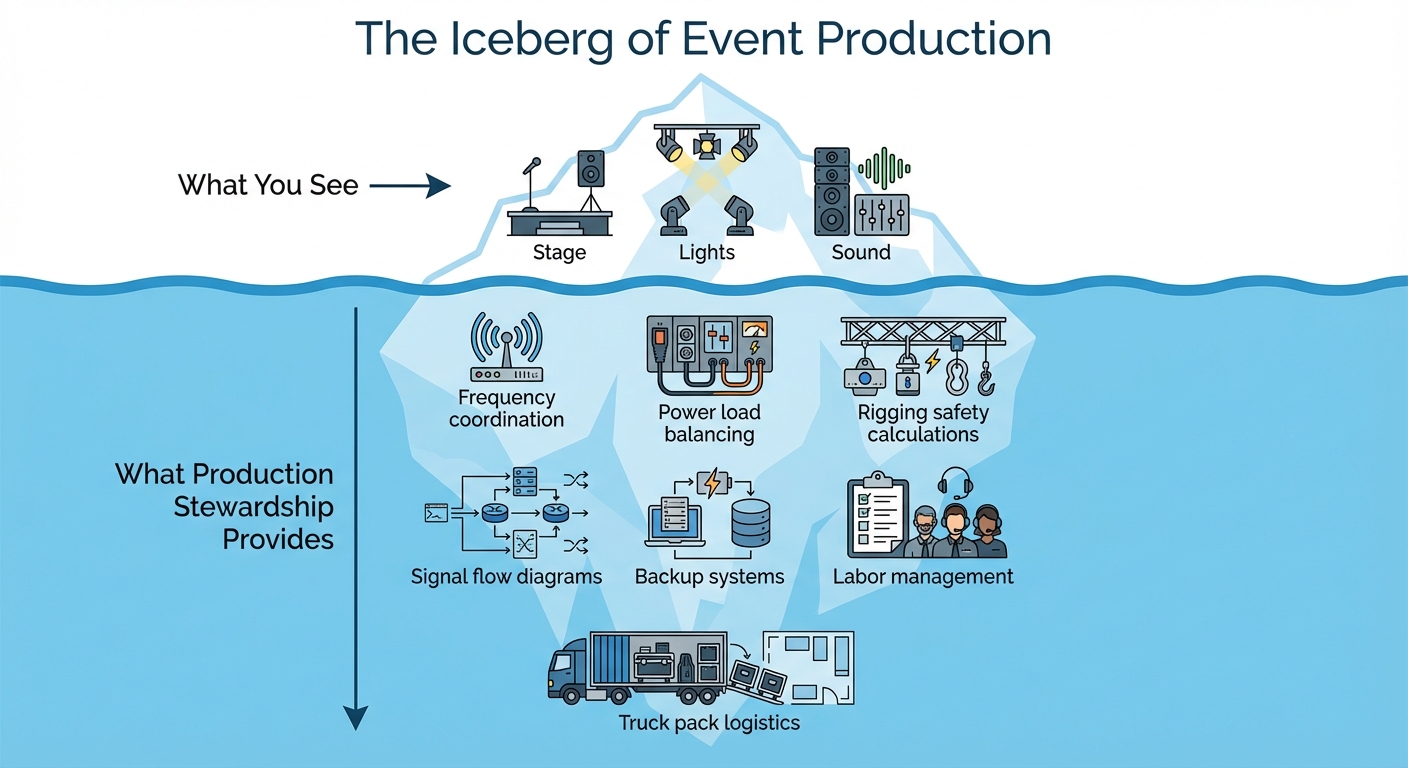
This visualization illustrates what’s really happening during professional event production. The visible elements—the stage, lights, and sound—represent only a fraction of the work. Below the surface lies massive infrastructure: frequency coordination, power load balancing, rigging safety calculations, signal flow diagrams, backup systems, labor management, and logistics planning. This hidden complexity is precisely what Production Managers navigate to create that seamless, “invisible” technical experience.
Success Story: The Corporate Town Hall
A Fortune 500 company hosts its quarterly executive address for 800 employees, with an additional 500 joining remotely. Rather than renting a PA system and projector, they engage a full production team from Pro Connect Group.
The production team manages multi-camera switching to keep the visual presentation dynamic, ensures PowerPoint content displays correctly on LED walls with appropriate contrast ratios, and provides redundant audio feeds for both in-room and streaming platforms.
Midway through the presentation, the venue’s internet connection becomes unstable. Without missing a beat, the production team seamlessly switches to a cellular bonded backup connection. The remote audience experiences no disruption. The executive’s message reaches both in-person and remote audiences without interruption, maintaining message clarity and professional brand image throughout.
The result: The company’s quarterly communication achieves its objectives. Employees report high engagement scores. Leadership delivers critical strategic messaging without technical distraction. The production investment protected the company’s internal communication objectives and brand standards.
Industry Trends Driving the Need for Professional Support
Why Events Are Getting More Complex (And DIY Is Getting Riskier)
Three converging trends are making professional production support increasingly essential for successful events. Understanding these trends helps explain why the gap between DIY approaches and professional execution continues widening.
Technological Sophistication: Events now routinely incorporate LED video walls, projection mapping, spatial audio systems, and real-time content management—technologies requiring specialized certification and experience. These aren’t simply “upgraded” versions of traditional equipment; they’re fundamentally different systems requiring distinct skill sets. A technician proficient with analog mixing consoles doesn’t automatically possess the software expertise required for digital signal processing and network audio protocols.
Hybrid Event Expectations: The post-pandemic landscape expects seamless integration of in-person and virtual experiences. According to Cvent, 28% of event planners cite “technological needs” as their biggest challenge in executing events. Hybrid events don’t simply add a webcam to traditional setups—they require coordinated multi-platform content delivery, real-time production switching, broadcast-quality audio mixing, and network infrastructure that maintains professional standards across all platforms simultaneously.
Elevated Audience Expectations: Consumer experiences with high-production entertainment—concerts, theatrical productions, streaming content—have raised baseline expectations for all events. Your audiences attend concerts with sophisticated lighting designs and attend conferences with multi-screen presentations. They stream professionally produced content daily. These experiences establish their baseline expectations. Technical execution that would have seemed adequate a decade ago now appears unprofessional by comparison.
Content Integration Complexity: Modern presentations integrate multiple content sources simultaneously—live speaker cameras, pre-recorded video packages, PowerPoint presentations, social media feeds, audience polling displays, and live captioning for accessibility. Managing these content streams requires real-time production decision-making, signal routing expertise, and backup systems for each stream. A single operator managing all these elements without specialized training and redundant systems is attempting a high-wire act without a safety net.
Regulatory and Safety Requirements: Professional production ensures compliance with electrical codes, rigging safety standards, and accessibility requirements including ADA-compliant captioning and assistive listening systems. These aren’t optional enhancements—they’re legal requirements. Organizations that handle production internally often overlook these compliance factors until they face accessibility complaints or safety violations. Professional production teams maintain current knowledge of these requirements and implement them as standard practice.
The ROI of Experience: Organizations increasingly recognize that event quality directly impacts brand perception, employee engagement, customer relationships, and fundraising outcomes—making technical execution a strategic investment rather than an operational expense. The shift from viewing events as logistical necessities to strategic assets changes how production quality should be evaluated. When your event drives business development, strengthens donor relationships, or communicates organizational values, production quality becomes a strategic priority rather than a line-item cost.
📊 Market Data Insight
According to the American Express Global Business Travel 2024 Forecast, 67% of meeting professionals predict increased meeting spend this year, specifically for higher-quality in-person experiences. This trend reflects organizational recognition that event quality delivers measurable returns.
Simultaneously, research indicates that 49% of marketers identify audience engagement as the biggest contributor to event success—engagement that’s directly impacted by production quality.
The convergence of these trends creates an environment where professional production support transitions from “nice to have” to “essential for success.” Events are more complex, audiences are more demanding, and the business stakes are higher. DIY approaches that might have succeeded in simpler contexts now carry unacceptable risk.
Making the Right Decision for Your Event
A Strategic Framework for Choosing Between Rentals and Production
The decision between equipment rental and full-service production should be strategic, based on your event’s specific goals, risks, and stakeholder expectations. This framework helps you evaluate which approach protects your interests.
Risk Assessment Questions:
What happens if the technology fails during your event? Is this event being recorded or live-streamed to external audiences? How important is this event to your organization’s reputation or revenue? These fundamental questions establish the risk context. For events where technical failure creates minimal consequences—a small internal meeting, for example—rental approaches may suffice. For events where technical failure damages your brand, loses revenue, or undermines critical messaging, production becomes essential risk management.
Audience Size and Type:
Events exceeding 50 attendees or including external stakeholders—customers, donors, media, industry partners—generally warrant professional production. Once your audience includes people outside your organization, you’re managing brand perception and relationship development. Technical execution reflects organizational professionalism. External stakeholders judge your organization by what they experience, including production quality.
Message Criticality:
Executive communications, fundraising appeals, product launches, and brand-defining moments require flawless technical execution. When your CEO delivers strategic direction, when donors decide whether to contribute, or when customers evaluate your products, the message cannot be compromised by technical problems. These moments are too valuable to risk.
Internal Capacity Reality Check:
Does your organization employ certified audio/video technicians with available bandwidth? If not, delegating technical responsibility to non-specialists is high-risk. Well-intentioned staff members without specialized training cannot deliver professional results. Asking your marketing coordinator to “figure out the sound system” places unfair pressure on that individual and exposes your event to unnecessary risk.
Budget vs. Investment Mindset:
Frame the decision as “what level of risk can we accept” rather than “what’s the cheapest option.” When you evaluate production as risk management rather than expense management, the calculation changes. A $5,000 production investment that protects a $200,000 fundraising goal is prudent risk management. A $3,000 “savings” that jeopardizes that fundraising goal is false economy.
The Pro Connect Group Approach
Organizations benefit from partners who provide strategic consultation, helping clients identify the appropriate service level for each specific event rather than pushing unnecessary services. At Pro Connect Group, we recognize that not every event requires full production. Our role is helping clients understand where rentals suffice and where production becomes essential. This consultative approach builds long-term relationships based on trust rather than maximizing every transaction.
Decision Framework:
Consider this logical progression when evaluating your event:
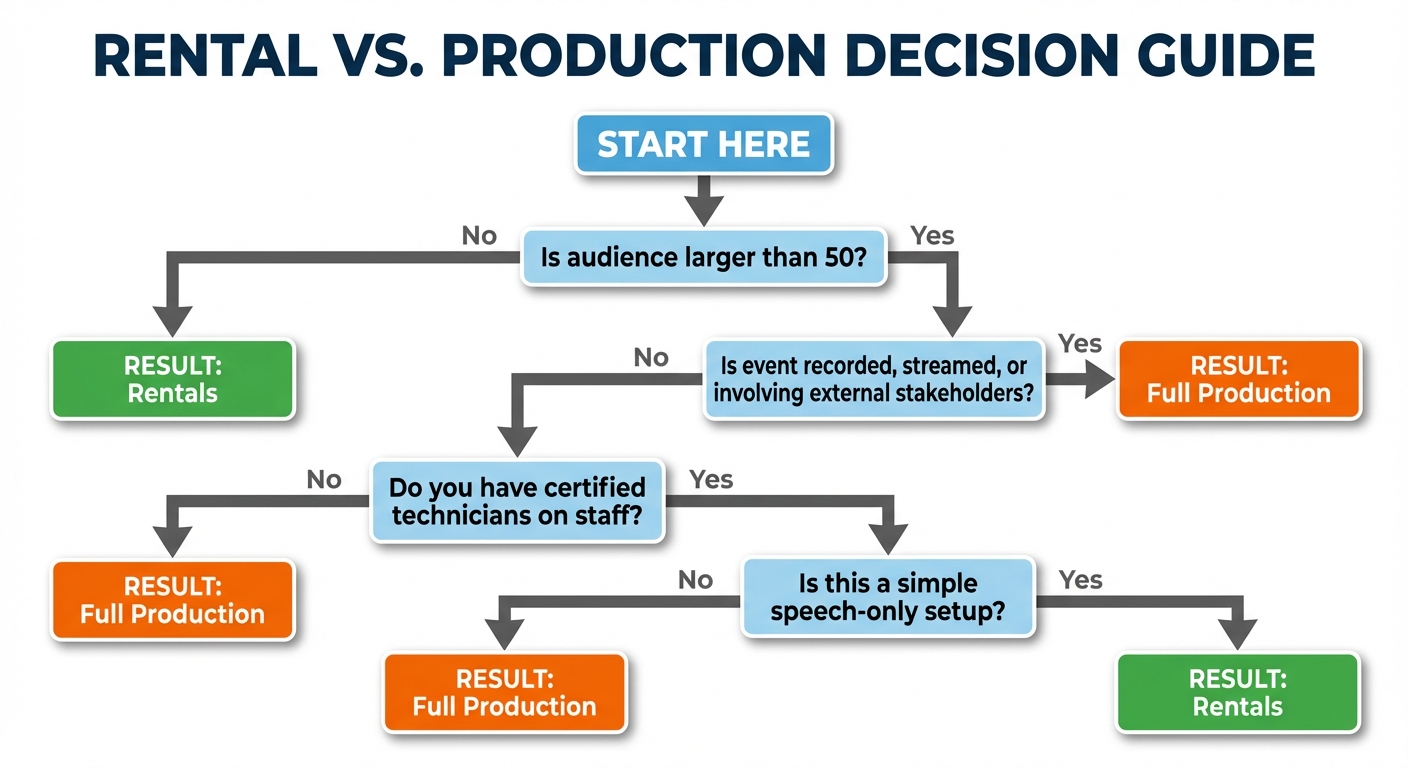
- Is your audience larger than 50 people? If yes, proceed to question 2. Larger audiences require more sophisticated systems and carry greater risk exposure.
- Is this event being recorded, streamed, or including external stakeholders? If yes, full production is recommended. Once your event extends beyond the immediate room, you’re managing multi-platform delivery and external brand perception.
- Do you have certified technicians on staff with available capacity? If no, full production is recommended. Without specialized expertise available, attempting DIY production is unnecessarily risky.
- Is this a simple “speech only” setup with no music, video, or multiple presenters? If yes, rentals may suffice. Straightforward applications with minimal technical complexity can succeed with rental equipment when qualified operators are available.
- Is brand reputation or revenue directly tied to this event’s success? If yes, full production is recommended. When business outcomes depend on event success, production quality becomes strategic priority rather than operational expense.
This framework provides a structured approach to decision-making. Most corporate events, nonprofit galas, and significant organizational gatherings will indicate full production through this evaluation. Small, internal, low-stakes meetings may reasonably use rental approaches when qualified operators are available.
Key Takeaways
The choice between AV equipment rentals and full-service production isn’t about finding the cheapest option—it’s about strategically managing risk and investing in outcomes. While rentals serve functional purposes for simple, low-stakes scenarios, professional production management becomes essential when brand reputation, message clarity, and audience engagement are on the line.
As event expectations continue rising and technology becomes more sophisticated, the gap between DIY attempts and professional execution widens. Organizations that recognize production quality as a strategic investment rather than an operational expense position themselves for success.
For Pro Connect Group clients, the decision comes down to this: Are you renting gear, or are you investing in your event’s success? Professional production partners don’t just deliver equipment—they take stewardship of your technical success, allowing your message, brand, and vision to take center stage.
Whether you’re planning a corporate town hall, nonprofit gala, house of worship service, or concert event, understanding these two approaches empowers you to make informed decisions that protect your investment and deliver the experience your audience deserves.
The right production strategy isn’t about spending more—it’s about spending strategically. When you understand the hidden costs of DIY approaches, recognize the value delivered by professional production management, and evaluate your specific event against a clear decision framework, you can confidently choose the approach that serves your objectives.
At Pro Connect Group, we’re committed to helping you make these decisions through transparent consultation and strategic guidance. We don’t push services you don’t need, and we don’t minimize risks you should understand. Our stewardship approach means we’re invested in your success, not just completing transactions.
Ready to Discuss Your Next Event?
Explore how professional production management can protect your event’s success and deliver measurable returns on your investment.
References:
- American Express Global Business Travel. (2023). 2024 Global Meetings and Events Forecast. https://www.amexglobalbusinesstravel.com/meetings-events/meetings-forecast/
- Professional Convention Management Association (PCMA). (2023). Trends in the Business Events Industry. https://www.pcma.org/news/
- Bizzabo. (2023). The State of In-Person B2B Conferences. https://www.bizzabo.com/blog/event-marketing-statistics
- AVIXA (Audio Visual and Integrated Experience Association). (2024). AV Standards and Best Practices. https://www.avixa.org/standards
- Cvent. (2024). Cvent Planner Sourcing Report: Europe Edition (Applicable Global Trends). https://www.cvent.com/en/blog/hospitality/event-planner-sourcing-trends
- Project Management Institute (PMI). (2024). Risk Management in Projects. https://www.pmi.org/learning/library/risk-management-event-projects-7369