Table of Contents
- Beyond Common Sense: The Legal Standards Governing Entertainment Rigging
- Understanding Load Dynamics: What Happens When Physics Meets Reality
- What You’re Actually Paying For: The Professional Rigging Difference
- The Indiana State Fair Tragedy: A $50 Million Lesson in Cutting Corners
- The Future of Safety: How Technology Is Raising the Bar
- Key Takeaways
On August 13, 2011, the unthinkable happened at the Indiana State Fair. As Sugarland fans waited for the show to begin, a sudden wind gust brought the entire stage roof crashing down. Seven people died. Fifty-eight were injured. The lawsuits eventually exceeded $50 million. Every single one of those deaths was preventable with proper rigging standards. This tragedy illustrates a harsh truth about live event production: When rigging is done correctly, nobody notices. When it’s done poorly, it makes national headlines—and destroys lives, reputations, and organizations. Budget-conscious clients often view rigging as an area to cut costs, not realizing they’re trading dollars for catastrophic liability exposure. The reality? OSHA reports that rigging-related accidents account for over 20% of workplace fatalities in entertainment and construction. The Indiana State Fair disaster led directly to the formation of the Event Safety Alliance and stricter enforcement of ANSI E1.21 standards. This article explains why professional rigging isn’t an “upsell”—it’s essential infrastructure that protects lives, reputations, and financial stability. For event planners, venue managers, and corporate decision-makers who bear ultimate liability, understanding the difference between professional and amateur rigging could be the most important knowledge you gain this year.
Beyond Common Sense: The Legal Standards Governing Entertainment Rigging
The regulatory landscape governing entertainment rigging creates a complex framework that separates professional operators from those simply meeting minimum requirements. Understanding this framework is critical for anyone bearing liability in event production.
OSHA’s Baseline Requirements
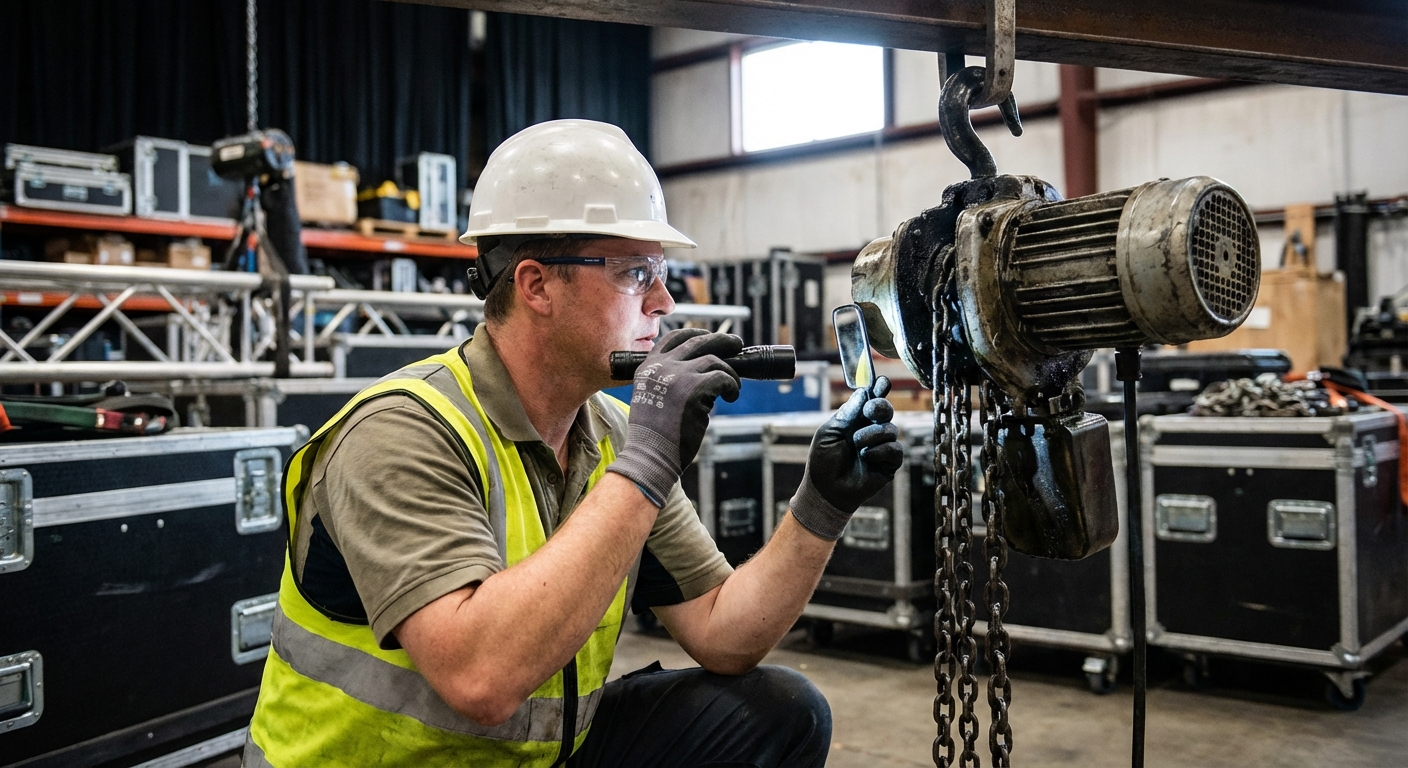
The Occupational Safety and Health Administration establishes federal safety baselines through 29 CFR 1926.251, which governs rigging equipment for material handling. This regulation requires that rigging equipment must be inspected before each use and immediately removed from service if defective. However, OSHA’s most powerful tool is often the “General Duty Clause” found in Section 5(a)(1) of the OSH Act. This clause holds employers liable for providing workplaces free from recognized hazards. When truss collapses occur, this catch-all regulation becomes the legal hammer, even when specific violations aren’t immediately apparent.
ANSI/ESTA Standards: The Industry Bible
While OSHA sets the floor, the American National Standards Institute (ANSI) and the Entertainment Services and Technology Association (ESTA) set the ceiling—and that’s where professional companies operate. ANSI E1.21 governs temporary outdoor structures including stages and truss roofs, establishing design requirements that far exceed general construction codes. ANSI E1.2 dictates aluminum truss manufacturing, welding protocols, and loading procedures—the standard that prevents metal fatigue failures. Here’s the critical distinction: These standards are technically voluntary. However, in lawsuits following rigging failures, courts consistently ask one question: “Did you follow industry best practices?” When the answer is no, liability becomes virtually inescapable.
The Professional Differentiator
Budget vendors meet minimum OSHA requirements. Professional production houses like Pro Connect Group adhere to ANSI standards, which demand significantly higher safety margins and more rigorous protocols. The Entertainment Technician Certification Program (ETCP) represents the industry’s gold standard credential—think licensed electrician versus handyman. ETCP-certified riggers understand not just how to hang equipment, but how to calculate loads, interpret engineering specifications, and recognize when conditions exceed safe parameters. The following table illustrates the stark differences in compliance levels:
| Compliance Level | Requirements | Typical Provider | Liability Risk |
|---|---|---|---|
| OSHA Minimum | Basic equipment inspection | Budget/generalist companies | High |
| ANSI E1.21/E1.2 | Engineered load calculations + inspections | Professional production houses | Low |
| ETCP Certified Personnel | Advanced training + ongoing education | Premium providers (PCG-level) | Minimal |
This distinction matters because liability doesn’t disappear when you hire the cheapest option—it transfers to you.
Understanding Load Dynamics: What Happens When Physics Meets Reality
Truss isn’t just “metal pipes”—it’s precisely engineered structural support governed by unforgiving physics. Understanding the forces at play separates professional rigging from dangerous improvisation.
Static, Dynamic, and Shock Loads: The Hidden Multipliers
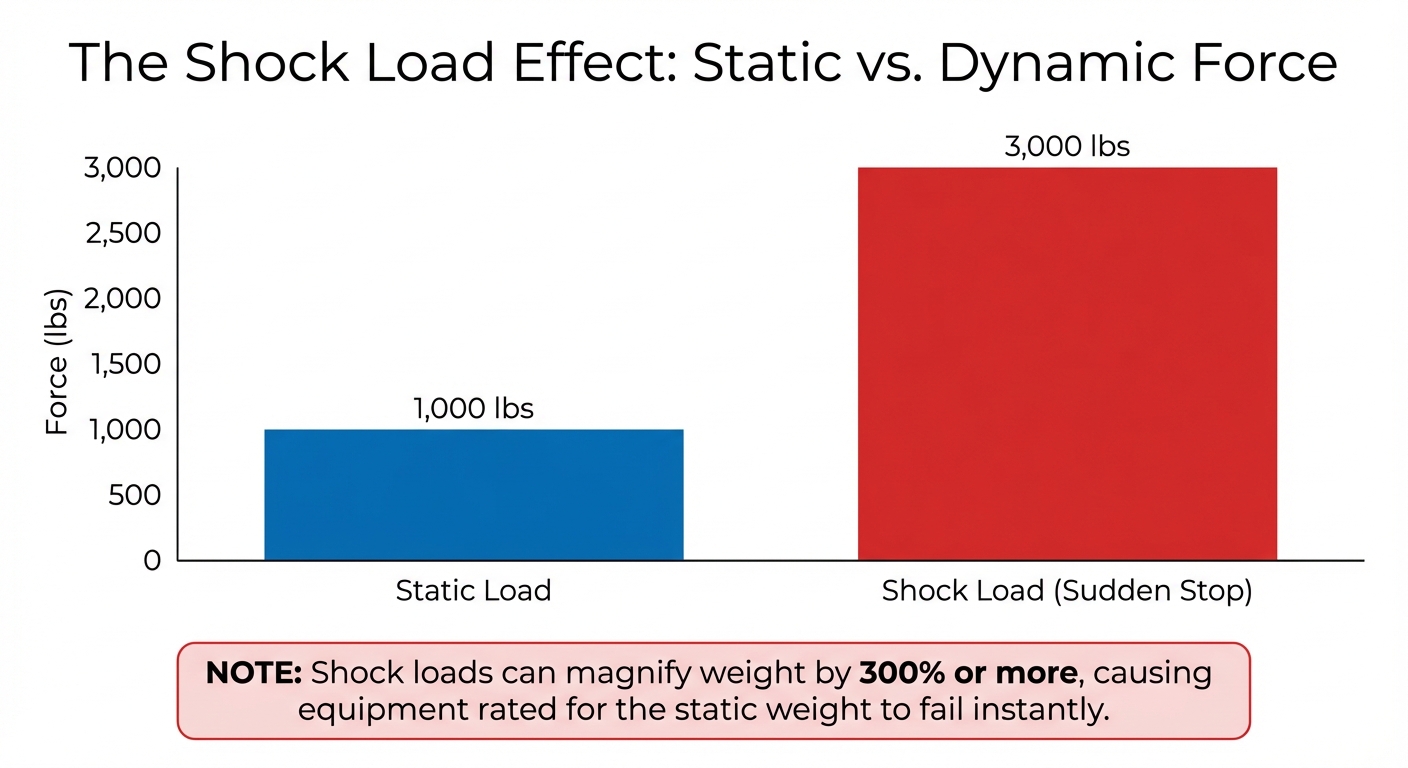
A speaker array hanging motionless represents a static load—straightforward weight bearing down on the rigging system. That same array being lifted or lowered by a motor creates a dynamic load, introducing motion-based forces into the equation. But the real danger lurks in shock loads—the instantaneous force generated when motion suddenly stops. If a motor halts unexpectedly while lowering a 1,000-pound speaker array, the shock load can magnify that weight by 300% or more, generating 3,000 pounds of force in a split second. This force can shear bolts, buckle truss, or snap cables if not properly calculated during planning.
The Crosby Group’s technical research confirms what professional riggers know: “The majority of rigging failures don’t occur due to exceeding static capacity—they happen when dynamic forces are ignored during planning.”
The Design Factor: Your Safety Margin
Entertainment rigging employs a 5:1 minimum safety ratio, meaning equipment rated for 5,000 pounds should never lift more than 1,000 pounds. This isn’t excessive caution—it’s physics-based engineering accounting for shock loads, material degradation, and real-world conditions. When human lives are directly at stake—such as flying performers—the industry requires 10:1 ratios. Professional companies maintain these margins religiously. Budget providers? They push equipment to absolute limits, operating on the “we’ve never had a failure…yet” philosophy.
The UDL vs. CPL Trap: Where Amateurs Get It Wrong
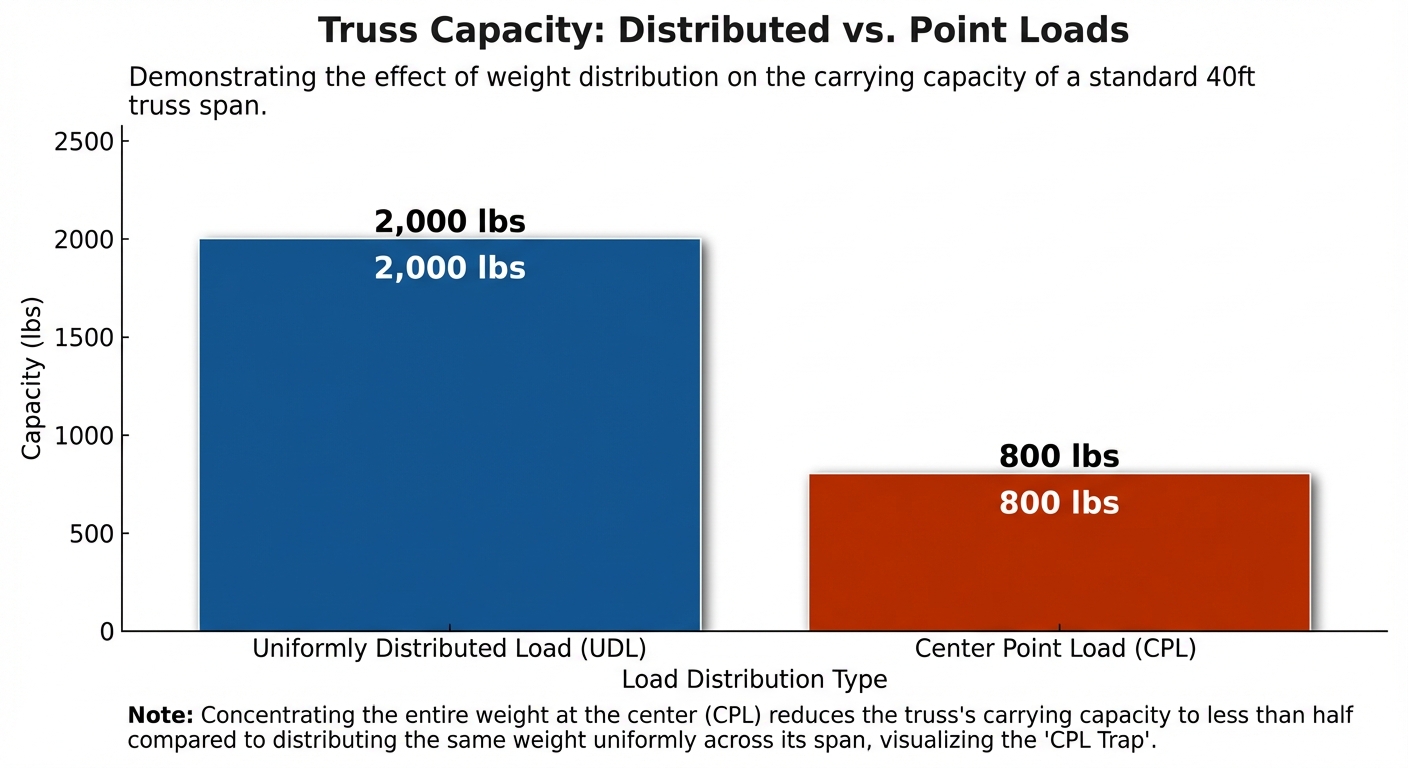
Understanding how weight distributes across truss separates knowledgeable riggers from dangerous ones. Uniformly Distributed Load (UDL) spreads weight evenly across the truss span. Center Point Load (CPL) concentrates weight at a single point—and dramatically reduces safe capacity. A 40-foot truss span might safely hold 2,000 pounds as a UDL but only 800 pounds as a CPL. This isn’t a minor technicality—it’s the difference between safe operation and catastrophic failure.
What You’re Actually Paying For: The Professional Rigging Difference
When clients question the cost difference between professional rigging companies and budget alternatives, they’re often comparing surface-level similarities while missing fundamental differences in methodology, expertise, and risk management.
Personnel Standards: Certification vs. Experience
Professional Standard: ETCP-certified riggers with documented training in ANSI standards form the backbone of companies like Pro Connect Group. These technicians understand load calculations, weather protocols, emergency procedures, and the physics governing every decision. Budget Alternative: General labor or “experienced” stagehands without formal certification. These workers rely on what they’ve seen before—essentially guesswork dressed as experience. The impact? Certified riggers can explain why a particular rigging configuration is safe or dangerous. Uncertified labor operates on instinct and hope.
Engineering and Planning: Documentation vs. Improvisation
Professional Standard: CAD drawings showing precise load distribution, rigging point locations, and structural analysis—all completed before load-in begins. Structural engineers review plans and provide stamped approvals when required. Budget Alternative: The “we’ll figure it out on site” approach with no documented engineering review and no calculations backing decisions.
Hardware Quality: Rated vs. Hardware Store
Professional Standard: Forged steel shackles with stamped Working Load Limit (WLL) ratings, such as Crosby G-209 shackles that deform visibly before breaking, providing warning of overload conditions. Budget Alternative: Hardware store shackles made from cast iron that fail suddenly and catastrophically without warning—brittle failure mode that offers no second chances. The cost comparison seems compelling at first glance: A rated Crosby shackle costs $15-25 versus $3 for a hardware store equivalent. That $20 savings could cost $20 million in lawsuits when failure occurs.
Truss Inspection Protocols: Systematic vs. Visual-Only
Professional Standard: Pre-event inspections documenting dents, cracks, and weld integrity. Damaged truss is immediately tagged and removed from inventory—no exceptions. Budget Alternative: Visual-only inspection where damaged truss remains in service until catastrophic failure occurs. The following matrix illustrates how these differences compound into vastly different risk profiles:
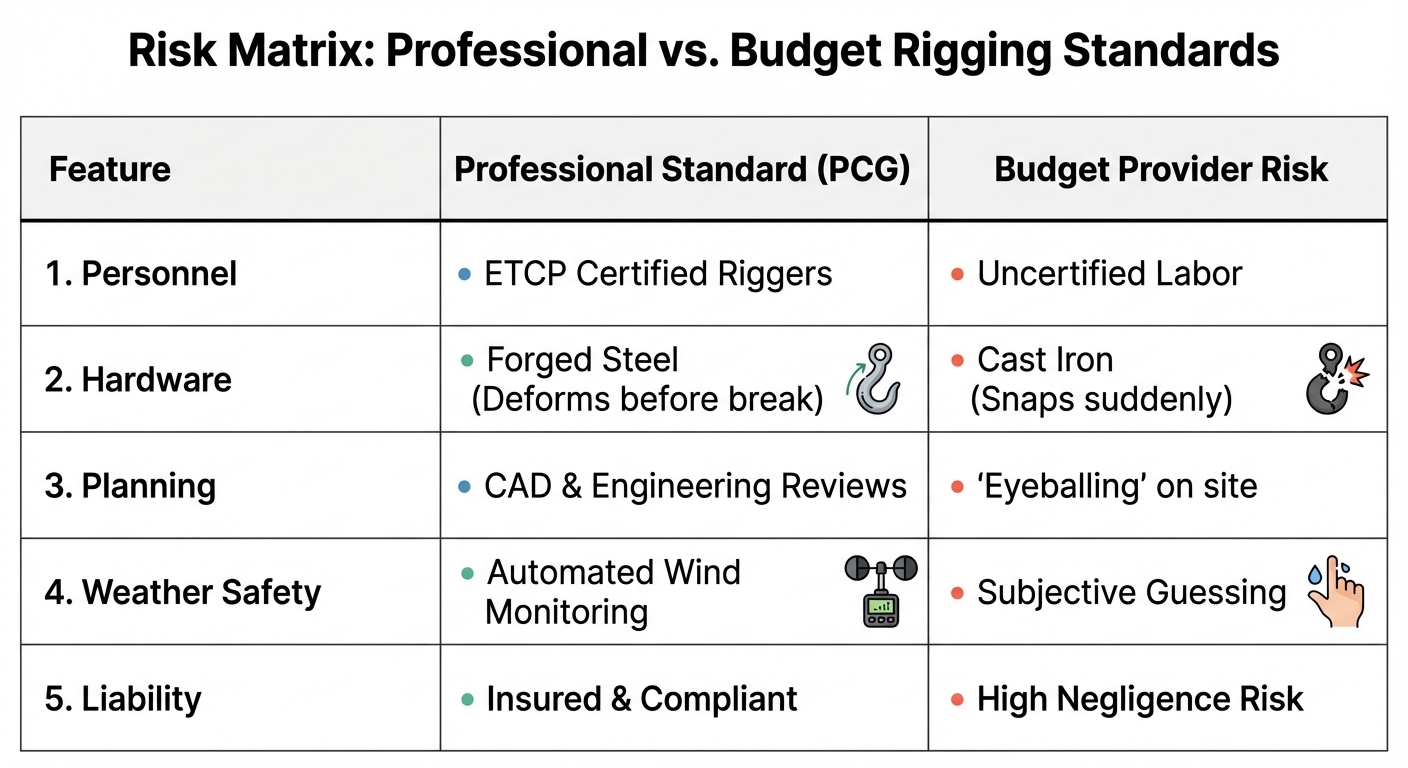
The pattern becomes clear: Professional providers invest in risk mitigation at every decision point. Budget providers cut corners at every opportunity, transferring catastrophic risk to clients who often don’t realize what they’ve accepted.
The Indiana State Fair Tragedy: A $50 Million Lesson in Cutting Corners
Some lessons are written in tragedy. The Indiana State Fair stage collapse remains the most infamous rigging disaster in modern entertainment history—and a case study in how cost-cutting kills.
The Incident
On August 13, 2011, as fans gathered for a Sugarland concert, wind gusts reached 60-70 mph. The temporary stage roof structure collapsed in seconds, killing seven people and injuring 58 others. Investigation revealed that the structure wasn’t engineered to withstand even 40 mph winds—far below the conditions that evening.
The Failures: A Perfect Storm of Negligence
- Insufficient Ballast: The guy lines anchoring the roof structure were dramatically under-weighted. Professional load calculations would have required significantly more concrete ballast to resist wind forces. The budget approach relied on hope instead of engineering.
- No Weather Action Plan: The event lacked a documented Event Safety Management Plan (ESMP) dictating when to stop the show based on wind speed. Professional productions maintain strict protocols—monitoring intensifies at 20 mph, structures must be lowered or evacuated at 40 mph.
- No Engineering Review: The temporary roof structure was never reviewed by a structural engineer, despite ANSI E1.21 requiring such review. This single omission set the stage for disaster.
The Aftermath: Consequences That Reverberate Today
Financial settlements exceeded $50 million paid to victims’ families—a staggering sum that destroyed organizations and careers. The tragedy led directly to the formation of the Event Safety Alliance, which published the Event Safety Guide (also known as “The Purple Guide”)—now the definitive industry reference document for event safety protocols. The insurance industry responded by requiring documented compliance with ANSI standards and proof of ETCP-certified personnel on-site for many events. Insurers recognized what the industry already knew: Professional standards save lives and money.
The Future of Safety: How Technology Is Raising the Bar
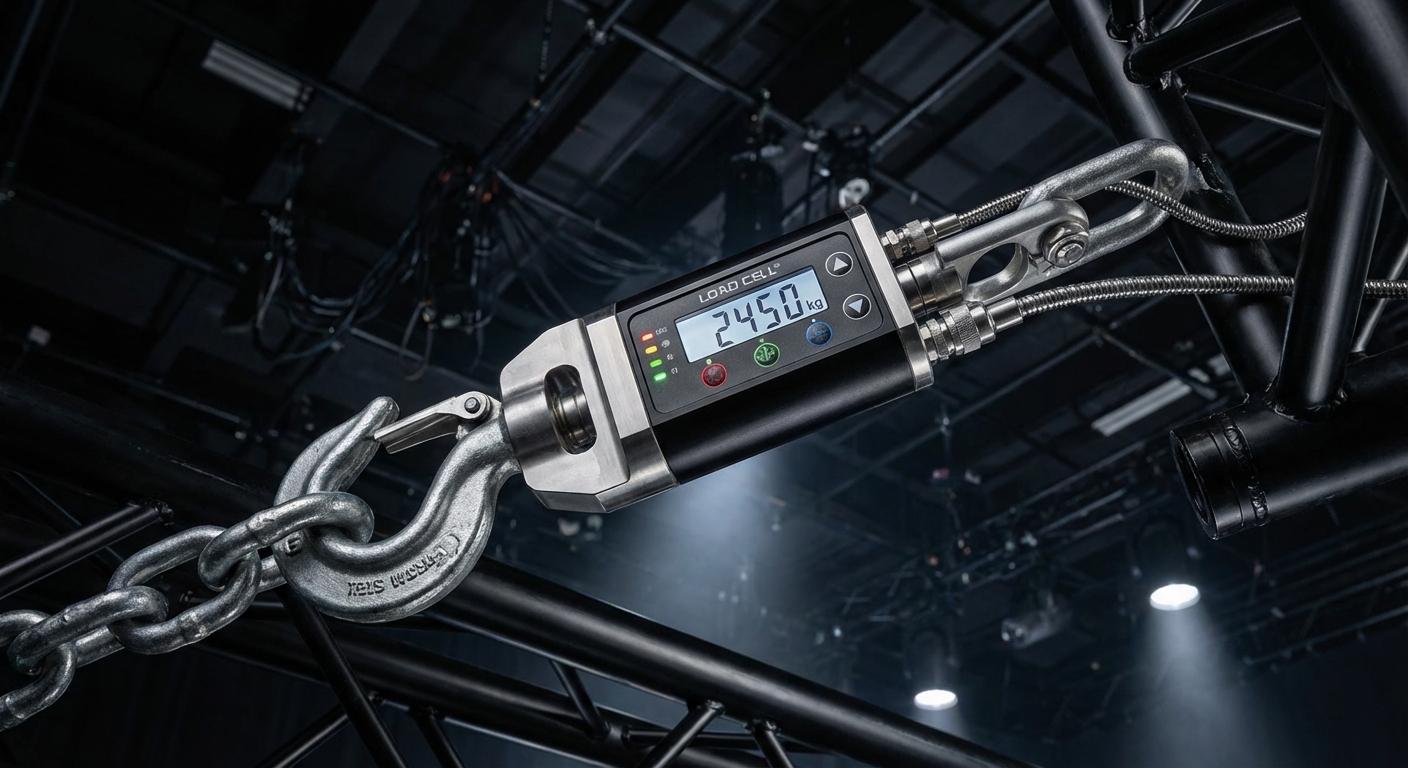
Professional rigging continues evolving beyond static best practices into a technology-enhanced discipline that raises safety standards across the industry.
Real-Time Load Cell Monitoring
Load cells—sensors placed between rigging motors and truss points—transmit live weight data to control stations, providing instant visibility into load distribution and any shifts that might indicate problems. The benefits transform risk management: operators instantly detect if loads become uneven, if weight shifts unexpectedly, or if total loads approach venue roof capacity limits. High-profile tours and corporate events increasingly require load cell data as documented proof of compliance. Companies investing in load cell systems demonstrate commitment to transparency and safety that budget providers simply cannot match.
Advanced Weather Monitoring Systems
Modern professional productions integrate on-site weather stations with real-time data feeds tracking wind speed, barometric pressure, and lightning detection. These systems feed directly into Event Safety Management Plans with specific action thresholds:
- 20 mph winds: Show monitoring intensifies, weather tracking becomes continuous
- 40 mph winds: Roof structures must be lowered or evacuated per National Weather Service guidelines
This systematic approach replaces the “it looks okay” weather assessment that contributed to the Indiana State Fair disaster.
Digital Inspection and Documentation
The shift from paper inspection logs to mobile applications creates unprecedented transparency and accountability. Modern systems photograph equipment, track service history across years, and automatically flag when inspections are overdue. For clients, this means timestamped, photo-documented proof that every piece of rigging hardware was inspected before use—evidence that becomes invaluable if questions ever arise.
Industry Certification Evolution
ETCP certification has evolved beyond generalist credentials into specialized certifications including Arena Rigger, Theatre Rigger, and Portable Staging Rigger. Professional companies maintain teams with multiple specialized certifications rather than relying on generalist labor. This specialization reflects the increasing complexity of modern productions and the recognition that expertise in one rigging environment doesn’t automatically transfer to another. The combination of these technological advances and enhanced certification standards creates a widening gap between professional providers who embrace innovation and budget alternatives stuck in outdated practices.
Key Takeaways
Safety in live event production operates on a simple principle: When rigging is done correctly, it’s invisible. When it fails, it becomes a tragedy that destroys lives, organizations, and careers. Professional rigging companies like Pro Connect Group ensure that the spectacle of your event is never overshadowed by preventable disaster. This commitment manifests across every decision:
- Regulatory compliance protects everyone. OSHA establishes minimum requirements, but ANSI/ESTA standards define professional excellence. Companies operating at the OSHA floor create risk. Companies operating at the ANSI ceiling—like PCG—mitigate it.
- ETCP certification ensures riggers understand the difference between “eyeballing it” and engineering it correctly. This distinction separates competent professionals from dangerous amateurs.
- The liability equation is remarkably simple. Hiring budget providers exposes event organizers to catastrophic legal and financial risk—the Indiana State Fair’s $50+ million settlement proves this beyond doubt. Hiring professional providers transfers that risk to experts with proper insurance, certifications, and proven safety protocols.
The next time a client questions the cost of professional rigging, the response should be clear: You’re not paying for metal and motors—you’re paying for decades of engineering expertise, regulatory compliance, and peace of mind. In an industry where a single failure can kill attendees and bankrupt organizations, cutting corners on rigging isn’t just irresponsible—it’s indefensible.
The choice isn’t between expensive rigging and affordable rigging.
It’s between professional safety standards and accepting catastrophic liability. One protects your organization. The other gambles with lives and futures.
Ready to Ensure Your Next Event Meets the Highest Safety Standards?
Contact Pro Connect Group to discuss how our ETCP-certified rigging team and engineered safety protocols protect your attendees—and your organization.
References:
- Occupational Safety and Health Administration (OSHA). (2024). 1926.251 – Rigging equipment for material handling. https://www.osha.gov/laws-regs/regulations/standardnumber/1926/1926.251
- Occupational Safety and Health Administration (OSHA). (2024). OSH Act of 1970 – Section 5(a)(1) General Duty Clause. https://www.osha.gov/laws-regs/oshact/section5-duties
- ESTA (Entertainment Services and Technology Association). (2024). Technical Standards Program – Published Documents. https://tsp.esta.org/tsp/documents/published_docs.php
- Crosby Group. (2023). Understanding Dynamic Loading in Rigging. https://www.thecrosbygroup.com/blog/dynamic-loading-and-its-effect-on-rigging/
- Area Four Industries. (2022). Truss Loading: UDL vs. CPL Explained. https://www.areafourindustries.com/news/truss-loading-explained
- Event Safety Alliance. (2024). The Event Safety Guide (The Purple Guide). https://www.eventsafetyalliance.org/the-event-safety-guide
- National Weather Service. (2024). Outdoor Event Safety: Weather Preparedness. https://www.weather.gov/safety/events