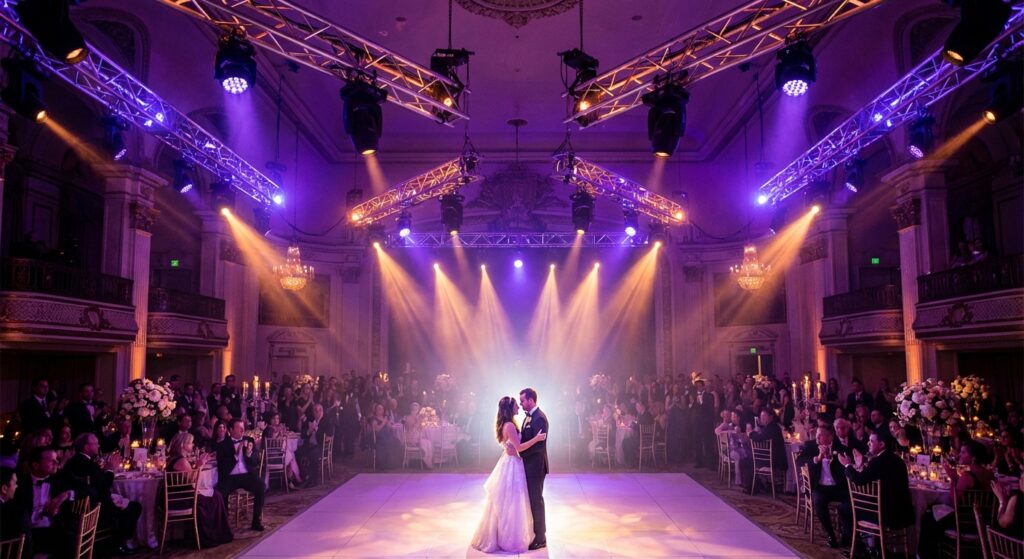
When you book a live performer for a corporate event — whether it’s a keynote entertainer, a jazz trio for your gala dinner, or a headliner band for a company celebration — you’ll receive a technical rider. This document is the artist’s formal list of audio, video, lighting, and staging requirements. Reading it correctly and sharing it with your AV production company is what separates a seamless performance from a last-minute scramble. This guide breaks down exactly what’s inside a tech rider and how to act on it.
Key Takeaways
- A technical rider is issued by the artist’s management and specifies audio, video, lighting, and staging requirements for the performance.
- You don’t need to understand every technical spec — your AV production company translates the rider into gear and crew.
- Always send the full rider (plus stage plot and input list) to your production partner at least 4–6 weeks before the event.
- Pay close attention to hard requirements versus preferred specs — riders often mix the two.
- Budget for rider fulfillment as a separate line item — costs range from negligible to $25,000+ depending on the artist’s tier.
What Is an Artist Technical Rider?
A technical rider is a contract addendum issued by the artist through their management or booking agent. It specifies everything their team needs to perform: sound system requirements, stage configuration, lighting, video, and power. It’s legally binding — if you can’t provide what’s in the rider, the artist can cancel or renegotiate. Think of it as a shopping list, a blueprint, and a set of ground rules in one document.
Technical riders are separate from hospitality riders, which cover dressing rooms, catering, and ground transportation. When your AV production company asks for “the tech rider,” they mean the technical document only.
The Six Main Sections of a Technical Rider
1. Stage Plot
The stage plot is a diagram showing where each performer stands, where equipment is positioned, and how the stage is configured. It communicates minimum stage dimensions (width and depth), monitor and amplifier placement, and special setups like drum risers. If your venue’s stage is smaller than what the rider requires, this must be resolved before you finalize the artist contract.
2. Input List
The input list is a channel-by-channel breakdown of every microphone, direct input (DI), and audio feed the artist’s team requires. It lists the instrument or vocal on each channel, preferred microphone model, DI requirements, and signal routing notes. For a seven-piece band, you might see 24 or more channels. Your AV production company uses this to configure the mixing console, prepare the stage box, and build monitor mixes.
3. Audio Requirements
This section specifies the front-of-house (FOH) sound system: PA coverage zones, subwoofer configuration, preferred console brand (e.g., “Avid VENUE S6L or equivalent”), and any outboard gear. Many touring FOH engineers carry saved show files on a specific console model — switching platforms can add hours of setup time. Monitor requirements are often listed separately and include wedge count per performer, in-ear monitor (IEM) systems, and sidefill speakers. Wireless IEM systems alone run $800–$2,500 per channel to rent, so rider complexity directly affects your budget.
4. Lighting Requirements
Lighting specs range from minimal (“adequate front wash, no strobes”) to detailed plots specifying moving head counts, color temperature, hazer output, and a required console model. If the artist travels with their own lighting director, you’ll need to provide a console they know — typically a grandMA2 or grandMA3. For most corporate event riders, a quality front wash and color coverage fulfills the spec without requiring additional equipment.
5. Video and Backline
Some riders specify IMAG screens, confidence monitors for lyrics or cues, or content playback screens. Backline (amplifiers, drum kit, keyboard stands) is sometimes provided by the artist and sometimes required from the local production company with specific brands listed. Clarify this early — sourcing backline from a separate vendor can complicate load-in logistics.
6. Power and Electrical
Power requirements are frequently overlooked by event planners until load-in day. A touring act may require a dedicated 200-amp service, specific breaker configurations, or clean power conditioning for sensitive audio electronics. If your venue’s electrical doesn’t match, your production company needs to bring a generator or power distribution unit (PDU). Power mismatches are one of the most common causes of show delays at load-in.
How to Get the Rider to Your AV Production Company
- Request the rider immediately after signing the artist contract. Don’t wait. Some specialized gear requires weeks to source from other markets.
- Forward the complete rider PDF — don’t summarize it. Stage plots, input lists, and lighting plots are often separate attachments that are just as critical as the main rider text.
- Schedule a rider review call. A 30-minute walkthrough with your production team surfaces problems early: a console model that needs to be sourced, a monitor count that exceeds your package, or a stage dimension that won’t fit the room.
- Identify what requires artist approval to substitute. Your production company can flag mandatory vs. negotiable items and help you draft a substitution request to artist management.
Common Rider Gotchas
The rider is outdated. Always confirm with management that you have the current version, especially if the artist has toured recently.
The sound check window isn’t in your schedule. Most acts need 2–4 hours of stage access before doors open. A gala starting at 6:00 PM with entertainment at 8:00 PM means the artist’s team needs stage access by 4:00 PM — and your AV crew needs to be fully set before that. This drives catering, room flip, and registration timelines.
The rider requires a union crew call. Some riders for nationally touring acts require IATSE or IBEW crew. Verify this early — it affects staffing and cost.
Technical and hospitality riders are bundled together. Send everyone the full document but make sure each party — AV company, venue, caterer — owns their sections.
What Does Rider Fulfillment Cost?
Cost scales with artist tier. A local jazz quartet may have a one-page rider your standard event audio system already covers, adding nearly nothing. A regional touring act might need a specific console upgrade and additional monitor mixes, adding $1,500–$4,000. A national headliner can arrive with a 40-page rider requiring $10,000–$25,000 in incremental production on top of your base AV package.
The smart approach: share the rider with your AV production company before finalizing the artist contract so you can price the true all-in cost. In our experience producing live entertainment at corporate events across the Pacific Northwest, planners who bring their production partner into talent negotiations avoid the most painful budget surprises.
Frequently Asked Questions
What is the difference between a technical rider and a hospitality rider?
A technical rider covers audio, video, lighting, staging, and power requirements for the performance. A hospitality rider covers dressing rooms, catering, beverages, hotel, and ground transportation. They’re often combined in one document but fulfilled by different parties — your AV company handles the technical side; the venue or event manager handles hospitality.
Who is responsible for fulfilling the technical rider?
The event planner — or whoever signed the artist contract — is contractually responsible for rider fulfillment. Your AV production company executes the technical requirements, but the obligation to the artist’s management sits with you. Engage your production team early so they have time to source everything required.
Can I substitute gear that doesn’t match the rider exactly?
Often yes — many items are listed as preferred and accept reasonable equivalents with prior written approval from management. Your AV production company can identify what’s truly mandatory versus negotiable. Never substitute without written approval.
How far in advance should I send the rider to my AV production company?
As soon as you receive it — ideally 6–12 weeks before the event. Specific console models, touring-spec wireless systems, and monitor configurations can have limited regional availability. Last-minute rider fulfillment is possible but carries a cost premium and increases substitution risk.
Do I need to understand the rider, or does my AV company handle it?
Your AV production company reads and executes the rider — you don’t need to understand every spec. What you do need: get them the full document early, facilitate introductions between your production team and the artist’s tour manager or FOH engineer, and make sure your event schedule includes the sound check window.
Work With a Production Partner Who Knows Riders
Reading and fulfilling technical riders is a specialty — one that requires deep familiarity with live entertainment production, the right professional gear inventory, and established sourcing relationships when a rider calls for something outside standard stock. Pro Connect Group provides audio, video, and lighting production for live entertainment at corporate events, galas, and celebrations throughout Portland and the Pacific Northwest. If you’ve booked an artist and have a rider in hand — or want to understand the production costs before you sign — contact our team and let’s walk through it together.