Professional stage lighting does two things at once: it ensures your audience can clearly see what you need them to see, and it shapes the emotional atmosphere of everything happening on stage. Get it right, and attendees leave feeling energized, impressed, and engaged. Get it wrong — flat wash lighting, harsh shadows, color temperatures that make speakers look sickly — and even great content struggles to land the way it should.
Key Takeaways
- Event lighting has three distinct layers: ambient fill, key lighting for presenters, and accent/effects lighting for atmosphere.
- Intelligent (moving head) fixtures offer programmable color, movement, and gobos — but require a skilled operator to deploy effectively.
- A lighting plot is a floor-plan-style document your AV production company creates before the event — always ask for one.
- Hazer and fog machines are different tools with very different results; confusing them is a common planner mistake.
- Stage lighting for a mid-size corporate event in the Pacific Northwest typically runs $3,000–$12,000, depending on rig complexity and crew days.
Why Lighting Is Your Most Underestimated Event Investment
Most corporate event budgets allocate significant dollars to venue, catering, and speakers — then treat lighting as an afterthought. That’s a mistake. Lighting is the one production element your audience experiences continuously, from the moment they walk in to the moment they leave. It frames every speaker, every award presentation, every brand moment on stage. In our experience producing events ranging from 50-person board meetings to 2,000-person galas, lighting is the single most common budget line that clients wish they’d increased after the fact.
The good news: understanding the fundamentals of stage lighting design doesn’t require a technical background. Once you know what to ask for — and what separates professional lighting from a rental drop-in — you can have smarter conversations with your AV production company and make confident decisions about where to invest.
The Three Layers of Professional Event Lighting
Think of event lighting as three distinct layers stacked on top of each other. A well-executed lighting design addresses all three.
Layer 1: Ambient Fill
Ambient fill lights the room evenly at a baseline level — it’s what prevents your ballroom from feeling like a cave when stage lights are up and house lights are down. Good ambient fill is usually warm and subtle: enough for attendees to see their programs and each other without washing out the stage. Poor ambient fill (either absent or overpowering) is one of the fastest ways to make an event feel amateurish.
Layer 2: Key Lighting
Key lights illuminate your presenters, panelists, performers, or award recipients — whoever is on stage. These are typically front-hung ellipsoidal fixtures (often called Source Fours or lekos) aimed at a defined stage area. The goal: faces are visible, skin tones look natural, and shadows are controlled. This is the most technically demanding layer, because a poorly angled key light creates shadows that make speakers look tired or unflattering on camera.
If your event includes any video or livestream component, key lighting quality directly impacts how good the footage looks. A well-keyed stage makes a standard camera package look polished; a poorly lit stage will frustrate even expensive camera systems.
Layer 3: Accent and Effects Lighting
This is the layer that transforms a functional event into a memorable one. Accent and effects lighting includes stage washes in brand colors, gobos (patterns projected onto surfaces), uplighting on columns or walls, moving head fixtures that add energy and movement, and atmospheric elements like hazer. It’s also the layer that varies most by event type — what works for a gala is very different from a daylong conference.
Intelligent vs. Conventional Fixtures: What’s the Difference?
Walk into any professional lighting conversation and you’ll hear the terms “intelligent fixtures” and “conventional fixtures.” Here’s what they mean in practice.
Conventional fixtures are static: you aim them, set a color using gel filters, and they stay in place. Source Four lekos, PARs, and Fresnels are the most common. They’re reliable, predictable, and excellent for key lighting and static washes. They’re also significantly more affordable to rent and operate than intelligent fixtures.
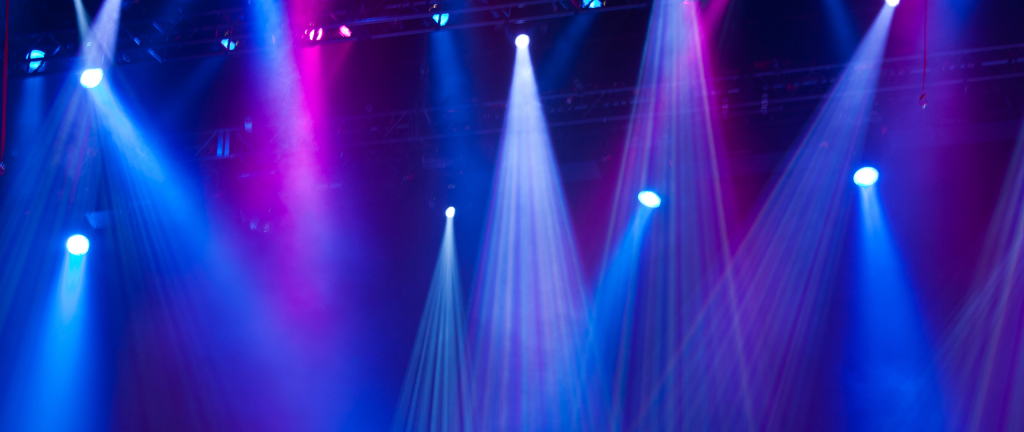
Intelligent fixtures — often called moving heads or movers — are motorized luminaires that can pan, tilt, change color, shift focus, and project patterns (gobos) on command from a lighting console. They’re the fixtures you see sweeping dramatically across a stage during an awards show opening. For corporate events, intelligent fixtures add significant production value during entrances, product reveals, and high-energy segments. They require a lighting programmer and a live operator, and that labor cost is real — but for the right events, the visual impact is unambiguous.
A professional AV production company will typically recommend a combination: conventional fixtures for the steady, functional work; intelligent fixtures for the moments that need to pop.
Lighting Design by Event Type
Conferences and Keynotes
The priority here is even, flattering key lighting that holds up under video capture. Attendees are reading slides, taking notes, and watching presenters for hours — ambient comfort matters. Color is usually neutral to match the brand palette, and effects lighting is minimal. A clean, professional look consistently outperforms a dramatic one for day-long conference formats.
Galas and Award Dinners
Galas are where event lighting becomes a genuine design element. Warm uplighting on architectural features, gobo patterns on walls or dance floors, intelligent fixture sweeps during award reveals, and dynamic transitions between dinner service and entertainment programming all contribute to an elevated atmosphere. Attendees remember how a beautifully lit gala made them feel — and that perception reflects directly on the organizing brand or nonprofit.
Product Launches and Brand Activations
Brand color accuracy is critical here. A product reveal lit in slightly wrong color temperatures undermines the branding investment. For launches, we work closely with event teams to match Pantone or brand hex values as closely as possible using LED fixtures, and we choreograph lighting cues to synchronize precisely with reveal moments.
The Lighting Plot: Ask for This Every Time
A lighting plot is a scaled diagram — similar to an architectural floor plan — showing where every fixture is hung, its type, its focus area, and how it connects to the dimmer and control system. A professional lighting design always begins with a plot.
If you’re hiring an AV production company for the first time, asking to see a lighting plot for your event is one of the best ways to gauge their professionalism. Experienced companies produce plots as a matter of standard process — it helps them load in efficiently, communicate with the venue, and brief crew on what goes where. Companies that wing it rarely produce plots. That difference shows up on show day.
Lighting plots also serve you as a client: they give you a visual record of what was agreed upon, which helps resolve any day-of discrepancies about fixture placement or coverage areas.
Atmospherics: Hazer vs. Fog Machine
One of the most common confusions we encounter: the difference between a hazer and a fog machine.
A hazer produces a very fine, even atmospheric haze across the room — often invisible to the naked eye but highly visible when a light beam passes through it. Haze is what makes beams from intelligent fixtures visible and dramatic in the air. Without it, you see the fixture and the lit surface, but not the beam itself. Professional productions almost always use haze for any show with moving lights.
A fog machine produces thick, dense fog — the kind associated with Halloween productions. Fog settles low, reads from across the room, and dissipates quickly. For corporate events, fog is rarely the right tool; haze almost always is. This distinction matters because some venues prohibit fog machines but permit hazers, and because the wrong choice significantly affects aesthetics and fire alarm sensitivity.
Always confirm with your venue about atmospheric effects policies before finalizing any lighting design that depends on them.
What Does Professional Event Lighting Cost?
Lighting budgets vary based on venue size, rig complexity, number of crew days, and event type. As a general benchmark in the Pacific Northwest market:
- Basic conference lighting (small-to-mid room, conventional fixtures, one operator): $2,500–$5,000
- Mid-range gala or corporate dinner (uplighting package, intelligent fixtures, full lighting plot): $6,000–$12,000
- Full production lighting for large conferences or live entertainment (complex rig, full crew, multiple show cues): $15,000–$40,000+
These figures reflect equipment, labor, and rigging — not venue fees. They’re designed to help you build a realistic budget, not to substitute for a formal quote. The most accurate number always comes from a detailed scope of work reviewed by your AV production partner.

Frequently Asked Questions About Event Lighting
How early should I bring in a lighting designer for my event?
Ideally, your AV production company — including whoever handles lighting design — should be engaged at least 6–8 weeks before the event. This allows time for a venue site visit, design collaboration, equipment sourcing, and production of the lighting plot. For complex events (large conferences, multi-day galas), 10–12 weeks is better. Last-minute engagements are possible but limit design options and may affect equipment availability.
Can I use the venue’s existing house lighting instead of bringing in production lighting?
Sometimes, but it depends heavily on the venue. Hotel ballrooms often have basic dimmer-controlled house lighting that works for simple dinners and breakout sessions. For any event with a stage, presenter, or brand presence, house lighting alone rarely delivers professional results — it typically produces flat, unflattering illumination without the ability to focus on specific areas or reproduce brand colors. Purpose-built theaters or convention centers may have theatrical-grade house systems, but they’re the exception.
Do I need a lighting operator for my event, or can the system run on autopilot?
For anything beyond a static look, you need a live operator. Lighting consoles are programmed with cues tied to show moments — speaker entrances, video rolls, award presentations, energy transitions. Someone needs to call and execute those cues in real time. Pre-programming handles much of the work, but a skilled operator adjusts on the fly when the show runs long, a speaker changes their sequence, or a last-minute addition hits the agenda.
What is a gobo and should I use one at my event?
A gobo is a metal or glass template inserted into a fixture to project a pattern — your company logo, a floral design, geometric shapes, or abstract textures. Gobos can be projected onto floors, stage backdrops, walls, or fabric cycs. Custom logo gobos typically cost $50–$150 to fabricate and can dramatically elevate a stage aesthetic. For branded events and galas, a custom gobo is one of the highest-return lighting investments available.
Does event lighting affect how my event photographs?
Significantly. Event photographers work with the available light, and that light’s quality directly impacts image quality. Harsh downlights create unflattering shadows under eyes and chins. Color gels that look beautiful in person can read strangely in photos. If photography or video is a priority, brief your AV production company early — they can adjust lighting plots to produce a camera-friendly environment while maintaining the atmospheric design you want.
Work With a Lighting Team That Treats Your Event Like a Production
At Pro Connect Group, lighting is one of three core services we provide alongside audio and video production — and we approach every event the same way: detailed lighting plot, pre-programmed cues, experienced operators, and equipment that performs reliably under show conditions.
Whether you’re producing a keynote conference at a Portland hotel, a gala at a Pacific Northwest venue, or a product launch that requires precise brand color reproduction, we’re ready to design a lighting system built around your specific goals — not a generic rental package dropped off at load-in.
Ready to talk through lighting for your next event? Contact Pro Connect Group to start the conversation with our production team.
See our intelligent lighting and fixture inventory: PCG Equipment Inventory →