Professional event lighting does more than illuminate a room — it shapes how your audience feels, how your speakers read on camera, and whether your event looks polished or thrown together. Whether you’re planning a corporate conference, a gala dinner, or a concert-style entertainment event, understanding the basics of event lighting design will help you communicate clearly with your AV production company and get a result that matches your vision.
Key Takeaways
- Event lighting has three core layers — ambient fill, stage wash/key light, and accent/effect — and most events benefit from all three.
- Intelligent (moving) fixtures offer real-time flexibility for multi-format events; conventional fixtures are reliable workhorses for static looks.
- A lighting plot is the design document your LD uses to hang, focus, and program fixtures — ask for one on any event over ~200 guests.
- Hazers (not fog machines) create the dramatic beam-in-air effect without irritating guests or triggering sprinkler systems.
- Professional event lighting in the Pacific Northwest typically runs $1,500 (basic uplighting, small venue) to $15,000+ (full intelligent rig with design, programming, and operator for a large gala or concert).
- Loop in your AV production partner early — venue walkthroughs ideally happen 4–6 weeks out, and touring artist rider review should happen as soon as the act is confirmed.
Why Lighting Makes or Breaks an Event
It’s the production element most event planners underbudget — and the one guests remember most when it’s wrong. Flat house lighting makes a $40,000 set look like a rec hall. Poorly aimed spotlights leave speakers half in shadow on screen. A well-placed key light and a clean stage wash, on the other hand, signal professionalism before a single word is spoken.
Conversely, a thoughtfully designed lighting scheme elevates every other production element. It makes your LED wall punch harder, flatters your speakers on camera, and creates the emotional arc that carries an audience from engaged to inspired. In our experience producing events across the Pacific Northwest, lighting is the single biggest multiplier for perceived production value per dollar spent.
The Three Layers of Professional Event Lighting
Most professional lighting designs — regardless of event size — are built on three layers. Understanding them helps you describe what you want and make sense of your AV production company’s recommendations.
1. Ambient and Fill Light
Ambient light is the base layer — it lifts overall room brightness so the space feels alive and guests are comfortable. Without proper fill, even a beautifully designed stage can feel dark and uninviting in the surrounding room. For corporate events, ambient fill is often accomplished with LED PARs or perimeter uplighting. The goal is even, flattering illumination that doesn’t compete with or wash out the stage look.
2. Stage Wash and Key Light
Stage wash covers your presenters and performers in consistent, camera-friendly light. Key light — a stronger directional source — fills in facial shadows and keeps speakers looking sharp on screen, which is critical when your event includes IMAG screens or a livestream component. Getting this layer right requires careful attention to color temperature, angle, and intensity relative to the ambient level and your camera’s exposure settings. A lighting engineer who doesn’t think about cameras is a problem at modern events.
3. Accent, Effect, and Architectural Light
This is where events start to look intentional. Accent lighting highlights set pieces, logo projections, or brand color moments. Architectural lighting uses the existing structure of the venue — columns, drape, ceiling coffers — as a canvas. Effect lighting includes gobo patterns, color mixing, and moving fixtures that signal transitions in program tone. For galas and entertainment-forward events, this layer is what most guests actually photograph and share.
Intelligent Fixtures vs. Conventional Fixtures
You’ll hear these terms constantly in conversations with your lighting designer. Here’s what they mean in practice.
Conventional fixtures (also called “dumb” fixtures) are fixed in place, aimed once at load-in, and controlled only for intensity via a dimmer. Ellipsoidal spotlights (ERS), Fresnels, and PAR cans fall into this category. They’re reliable, cost-effective, and ideal for looks that don’t need to change — a front-of-house key wash, a cyclorama flood, a consistent color wash that stays all night. For straightforward corporate presentations without complex program shifts, a conventional rig does the job cleanly.
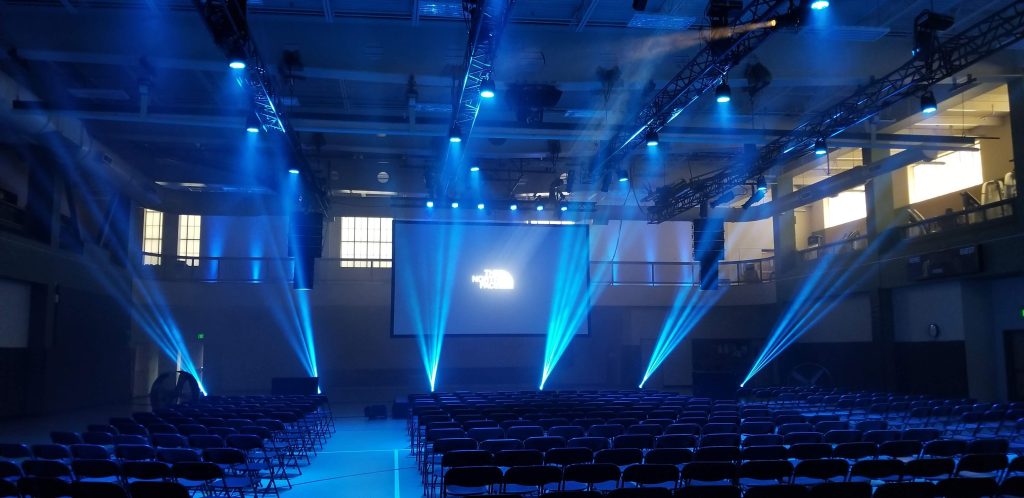
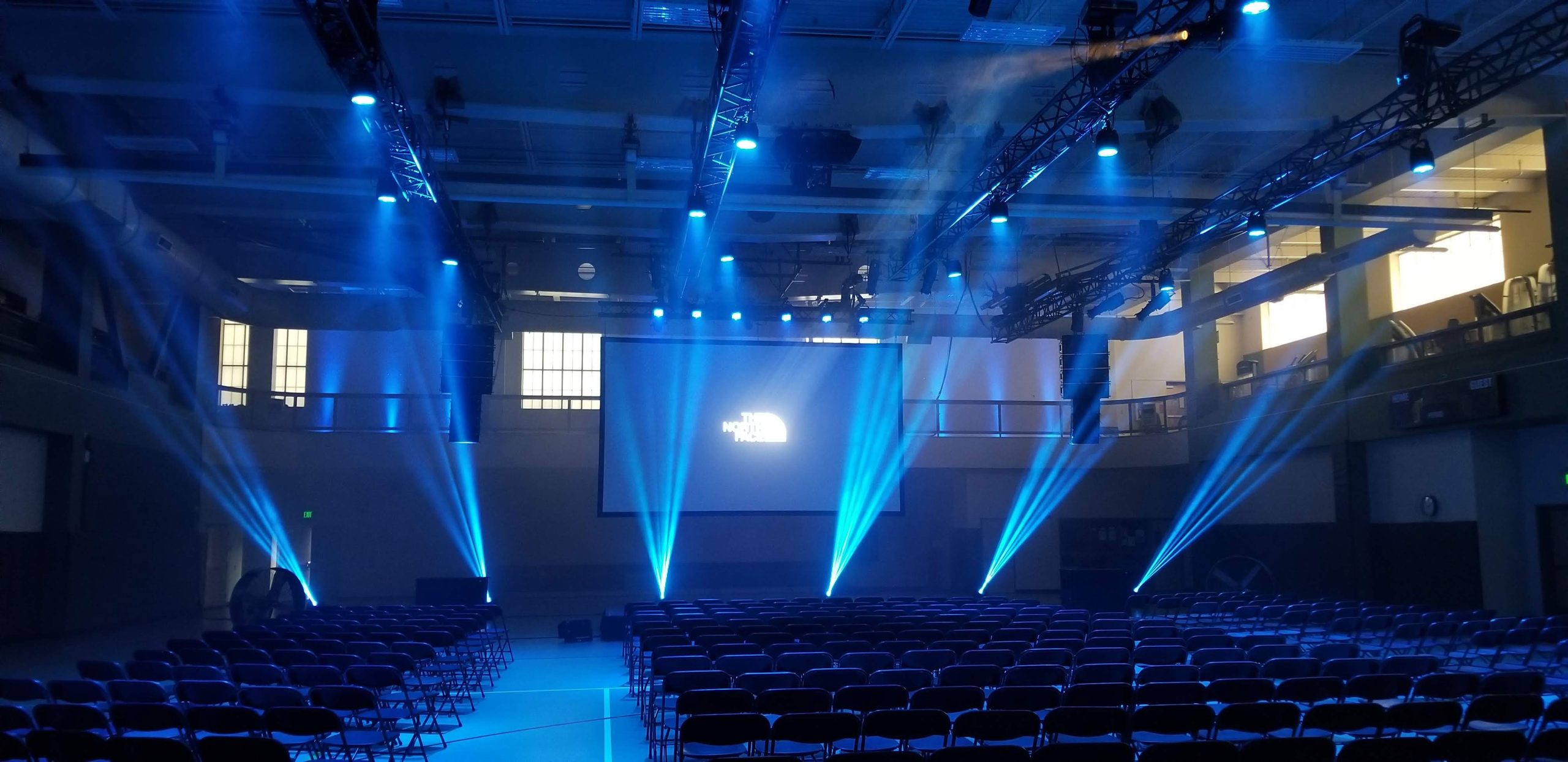
Intelligent (moving) fixtures can pan, tilt, change color, adjust beam focus, swap gobos, and strobe — all under console control, all in real time. A moving head wash fixture can light a speaker in warm white for a keynote, snap to a narrow blue spot for a video intro, and open to a full room fan for a standing ovation — without anyone touching a physical light. For multi-format events (conference by day, gala by night) or events with live entertainment, intelligent fixtures make dramatic scene changes possible in seconds.
Most professional event lighting rigs use a mix of both: conventional front wash for consistent, camera-friendly key light, plus intelligent fixtures for effects, set accents, and audience looks that follow the program.
What Is a Lighting Plot — and Do You Need One?
A lighting plot (sometimes called a lighting plan or rig plan) is a scaled diagram showing where every fixture hangs in the venue, what it’s aimed at, and what DMX address or circuit it occupies. It’s the document your lighting director uses to design the system, coordinate with the venue’s rigging and power infrastructure, and program the console before doors open.
For small events — a 75-person corporate dinner with simple uplighting — a formal plot may not be necessary. Your AV team will assess the room, hang lights based on experience, and focus on the day.
For larger events — anything over roughly 200 guests, events with complex staging, multi-day conferences, or concerts requiring rider compliance — a lighting plot is essential. It ensures the design is achievable within the venue’s grid and power capacity, gives the crew a load-in roadmap, and lets you approve the concept before any truck is loaded. Ask your production company to share the plot as part of the advance process; any reputable AV company should produce one for mid-size events and above.
Atmospherics: Hazers, Fog Machines, and Gobos
Nothing makes a moving light beam visible in mid-air like a room full of haze. That dramatic “beam from above” look you see at concerts and galas is created with a hazer — a device that disperses a fine, dry water-glycol mist into the air. Unlike a fog machine (which produces thick, low-lying ground fog), a hazer creates a subtle atmospheric layer that suspends evenly in the room and catches beam fixtures beautifully, without making guests cough or triggering venue fire suppression systems.
Two things to know before planning atmospherics:
- Always confirm with the venue first. Many hotel ballrooms prohibit haze due to HVAC configurations or sprinkler sensitivity. Some venues allow it with a fire marshal variance. Your AV production company should handle this coordination during the advance — it’s not the kind of thing to discover on load-in day.
- Gobos are metal or glass templates inserted into an ellipsoidal fixture to project a pattern — a corporate logo, a floral motif, a breakup pattern that mimics light through leaves. Custom laser-cut metal gobos typically cost $30–$80 each and should be ordered 2–3 weeks before the event for branded moments.
Lighting Needs by Event Type
Corporate Conferences and General Sessions
The priority is camera-friendly key light on presenters, consistent stage wash, and clean ambient fill in the house. Branding elements — logo gobos, corporate color washes on drape, set piece accents — add polish without distraction. Color temperature consistency is critical if the event is recorded or streamed. Expect to invest $2,500–$6,000 on lighting for a single-day conference in a mid-size ballroom (150–400 attendees), including crew.
Galas and Award Ceremonies
Galas reward a more theatrical approach. Cocktail hour calls for warm uplighting, candlelight-adjacent color palettes, and accent light on centerpieces and floral arrangements. The dinner program typically includes a lighting transition that signals the shift to awards — house dims, stage brightens, moving lights snap to attention. For galas with 300+ guests and entertainment components, a full intelligent rig with a dedicated on-site lighting operator is standard practice. Budget range: $5,000–$15,000+ depending on venue size and program complexity.
Concerts and Live Entertainment Events
Live entertainment events at corporate functions — branded concerts, headliner performances, festival-style activations — require the most sophisticated lighting packages and the most advance coordination. Artists’ technical riders often specify exact fixture types, beam counts, follow spot quantities, and lighting console models. Your AV production company will read the rider and spec a rig that meets or exceeds those requirements. Atmospheric haze is almost always part of the package for concert-style events. If you’re bringing a touring or regional act to your event, share the signed rider with your production partner as soon as you receive it — ideally eight or more weeks before the event date.
How to Brief Your AV Production Company on Lighting
The more context you give your production partner up front, the better the lighting design you’ll receive. When putting together your brief, include:
- Your program flow — what happens on stage, in what order, and for how long. Scene changes drive fixture choices more than any other factor.
- Your brand colors — provide PMS or hex codes, not just “navy and gold.” LED color mixing can get very close to brand standards with accurate references.
- Camera and recording plans — if the event is filmed or streamed, your lighting engineer needs to know before they design the rig. Key light angles and color temperature are set differently for a camera-optimized setup.
- Venue restrictions — rigging points, haze policy, power availability, union crew requirements. If you don’t know, ask your venue contact before the production meeting.
- Reference images — a Pinterest board or screenshot folder of lighting looks you like is worth a thousand words. Even rough visual references dramatically accelerate the design process.
- Your budget range — knowing whether you’re working with $3,000 or $10,000 shapes every recommendation your production company makes. A range is more useful than a hard cap.
Frequently Asked Questions About Event Lighting
How much does professional event lighting cost?
In the Pacific Northwest, professional event lighting typically ranges from $1,500 for basic uplighting in a small venue to $15,000 or more for a full intelligent rig with design, programming, and an on-site lighting operator for a large gala or concert. Day-of-show crew time, rigging labor, and power distribution are generally included in a full production quote from your AV company rather than itemized separately.
What’s the difference between a lighting designer and a lighting technician?
A lighting designer (LD) creates the concept, draws the lighting plot, programs the console, and calls cues live during the show. A lighting technician focuses on physical installation — hanging, cabling, and focusing fixtures. On larger events, both roles are typically staffed separately. On smaller events, an experienced LD handles both. When requesting a quote, ask specifically whether design and programming are included or billed as separate line items.
Can I use the venue’s house lights instead of renting a production lighting system?
Sometimes — but rarely for events with branding, entertainment, or camera components. House lights are designed for general room illumination, not for lighting a stage or creating a curated atmosphere. Most hotel ballroom fixtures are static with limited color options and basic dimmer control. If your event needs scene changes, camera-friendly key light, or a specific color palette, you’ll need supplemental production lighting. Your AV production company can advise after a walkthrough of the specific venue.
How far in advance should I book lighting production for my event?
For most corporate events, 6–10 weeks is the sweet spot — long enough to design the rig, order custom gobos, coordinate with the venue, and lock crew. For galas with entertainment components or events at high-demand venues where rigging and loading dock access must be scheduled in advance, 10–16 weeks is better. If your event involves a touring artist with a technical rider, get your production company involved as soon as the act is confirmed — some rider requirements take weeks to source.
Do I need a dedicated lighting operator on-site during the event?
For any event with scene changes — speaker transitions, video playback cues, award presentations, live entertainment — yes, a dedicated lighting operator is worth every dollar. They follow the program in real time, call cues, and respond to unexpected changes (a speaker running long, a last-minute walk-up, a technical delay that shifts the run-of-show). Events that try to run intelligent lighting on pre-programmed auto-run sequences almost always have awkward transitions at the worst possible moments. Budget for the human.
Professional lighting doesn’t have to be the biggest line item in your production budget to have the biggest impact on your event. Whether you’re producing a 100-person corporate meeting, a 500-person gala, or a branded entertainment experience with a live headliner, Pro Connect Group designs and operates audio, video, and lighting systems that match your vision and your program. We serve corporate event planners, in-house marketing teams, and venue clients across Portland and the Pacific Northwest. Contact PCG to talk through your next event — we’re happy to discuss fixture options, design concepts, and realistic budget ranges for your specific needs.